Deaths In ICE Detention Escalate
The January 2026 deaths continued the rise in fatalities seen in 2025. That year marked a 20-year high for deaths in ICE detention, coinciding with a 65 percent jump in the national detention population.

Since the beginning of 2026, the Camp East Montana temporary holding facility at Fort Bliss has recorded several deaths, making it one of the deadliest holding centers in the country. Two people have died at the facility thus far this month, following a third death in December 2025. In their disclosure about the latest death, ICE emphasized their “commitment to safe, secure, and human environments for all in custody, with comprehensive medical care provided from arrival.”
On January 14, medical staff pronounced 36-year-old Nicaraguan national Victor Manuel Diaz dead in a housing unit. Officials suspected suicide, but the investigation into the official cause continued. Diaz entered custody on January 6, 2026. Staff found him unresponsive and attempted immediate CPR, and a defibrillator was used before pronouncing him dead.
Earlier, on January 3, 55-year-old Cuban national Geraldo Lunas Campos died at the same facility. The El Paso County Medical Examiner preliminarily classified Campos’s death as a homicide caused by asphyxia from guards compressing his neck and torso. While ICE initially claimed “medical distress,” the DHS Office of Inspector General is now investigating allegations of excessive force. ICE maintains that the incident happened during an intervention for a suicide attempt, where the detainee violently resisted and that the staff tried to save him.
The January 2026 deaths continued the rise in fatalities seen in 2025. That year marked a 20-year high for deaths in ICE detention, coinciding with a 65 percent jump in the national detention population. The system recorded 32 deaths, matching the record set in 2004. For comparison, deaths ranged from 7 to 11 from 2023 to 2024. Texas holds a large portion of the national population, about 27,000 people. Consequently, the state accounted for eight deaths in 2025, or about 28% of the national total.
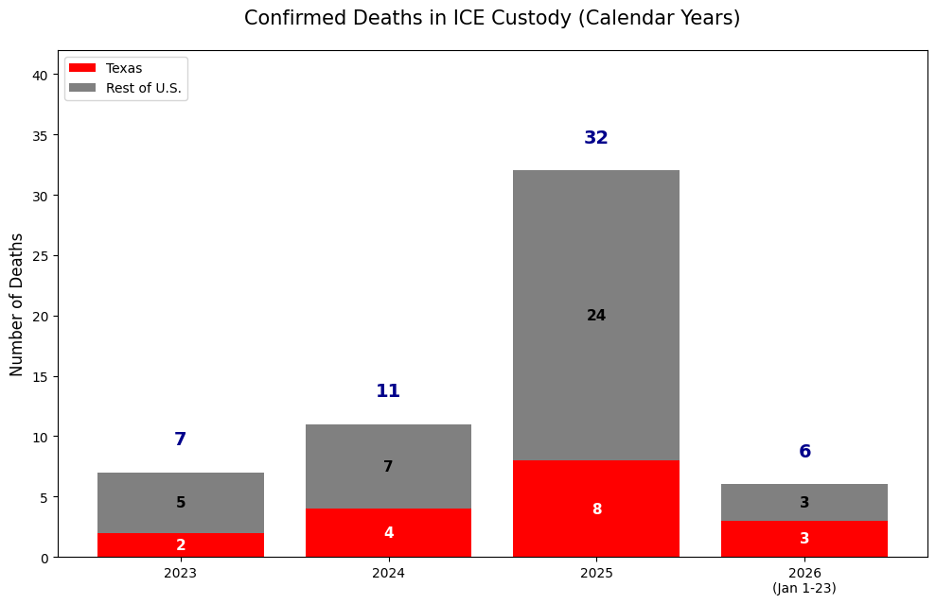
Human rights groups claim that medical neglect played a role in several of the eight Texas cases in 2025. For instance, Nhon Ngoc Nguyen died of pneumonia in El Paso in April; reports allege staff ignored his dementia symptoms. Francisco Gaspar-Andres died of renal failure in December. ICE classified these deaths as stemming from natural causes and emphasized that they provide comprehensive medical care to all detainees.
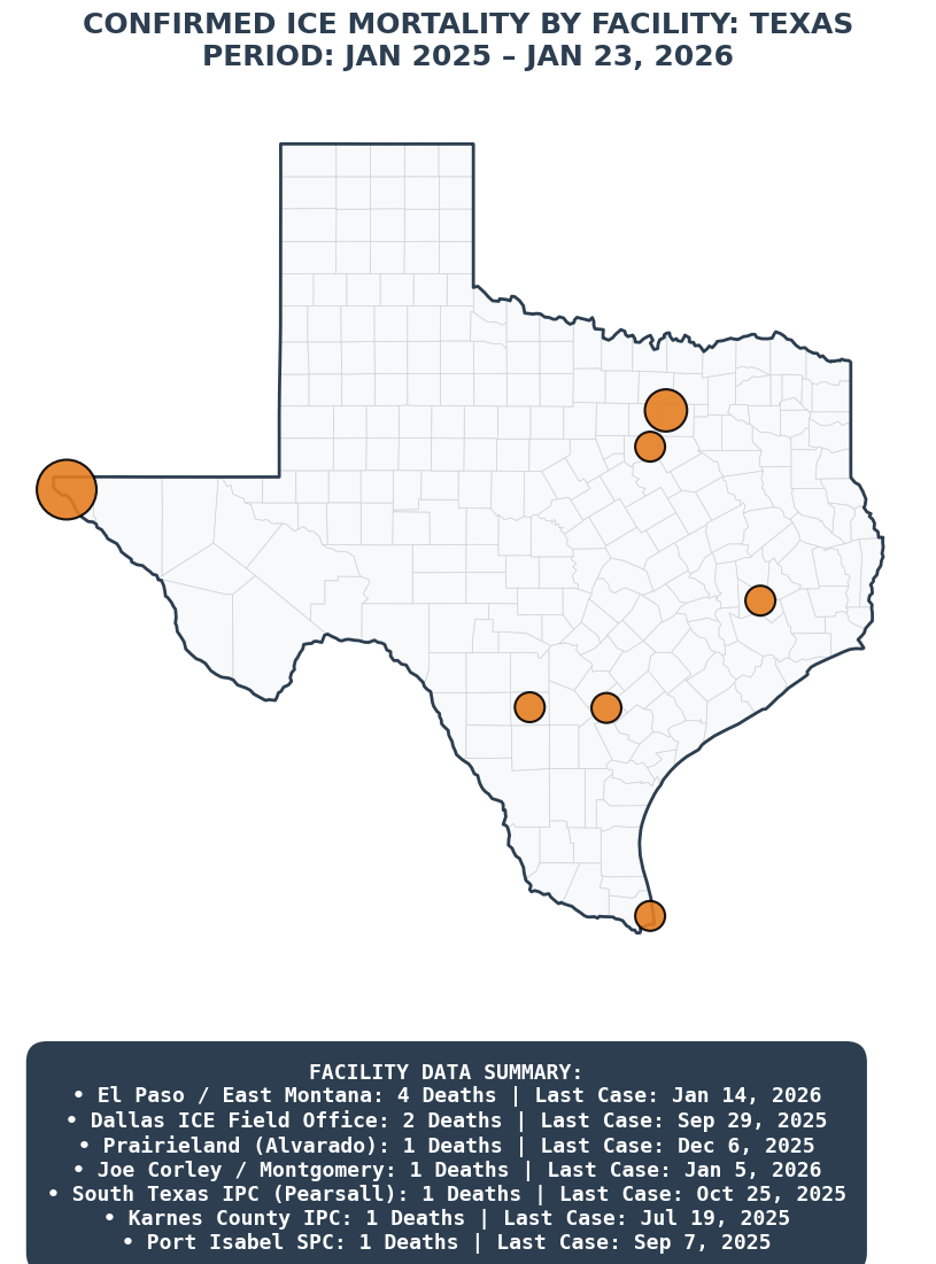
Camp East Montana is a “soft-sided” facility, a tent structure initially deployed to handle surge capacity. However, data shows these Texas sites suffer frequent incidents. El Paso and Camp East Montana accounted for 4 out of approximately 11 deaths in the state from January 2025 to January 2026.
Acquisition Logistics LLC, a contractor with no prior experience in corrections or detention management, operates Camp East Montana. In 2025, the company received a $1.24 billion contract from the Department of Defense. Experts argue that the resulting breakdowns in infrastructure and staff performance reportedly stem directly from the firm’s absence of specialized knowledge. Prior to this contract, their largest federal contract had been for just $16 million.
In 2025, amid overcrowded Texas hubs, ICE reportedly relied on informal visual assessments. Under extreme workloads, staff without specialized medical training could be prone to conduct rushed initial screenings. If a detainee lacked obvious signs of acute distress, agents were still allegedly clearing them for detention. ICE states that it provides comprehensive medical screenings upon arrival and remains committed to humane care despite surges.
The economic roots of this crisis lie in the contracts known as the Intergovernmental Service Agreement (IGSA) in Texas. Agreements with private contractors, such as GEO Group, distinguish between two payment rates. The base rate covers fixed costs for a minimum number of beds. However, a “Surge Rate” activates when overcrowding exceeds 100 percent.
To secure this guaranteed demand, private prison corporations launched significant lobbying efforts targeting the specific committees that write the federal budget. In the 2024–2025 cycle, GEO Group and CoreCivic collectively spent over $3 million on federal lobbying alone, focusing their efforts on the DHS Appropriations Subcommittee. These efforts coincided with the legislative increase of the detention bed mandate from 34,000 to 50,000 beds. This mandate legally compels ICE to fund these spaces regardless of need, effectively creating a stable source of federal funding for detention operations
Texas facilities have become the primary beneficiaries of this model, generating hundreds of millions in low-risk revenue. At the South Texas Family Residential Center in Dilley, CoreCivic secured approximately $180 million in annual revenue through a contract structure that bills the government for capacity rather than actual occupancy. Similarly, GEO Group boosted the Karnes County facility's yearly revenue to $79 million, capturing an additional $23 million by reclassifying the detainee population to include "mixed populations." These deals rely on "guaranteed minimums," a contractual mechanism that requires the government (and ultimately taxpayers) to pay for the beds' full capacity, even if some remain unoccupied.
This system also uses contract exceptions to keep staffing levels static and avoid understaffing penalties. Attorneys representing the family of Geraldo Lunas Campos have stated that understaffing may have contributed to the incident.
IGSA contracts provide contractors with significant protection from financial liability through indemnity clauses. Unless an investigation proves direct "willful misconduct," the federal budget pays for multimillion-dollar civil rights settlements under the Federal Tort Claims Act. Corporate insurance funds remain untouched, and profits stay intact.
This model raises questions about financial efficiency. Housing an adult in a soft-sided facility costs the budget approximately $150-$192 per day. This price rises to around $319 in family centers. Meanwhile, Alternatives to Detention (ATD) programs using SmartLink technology cost approximately $4.20. Detaining a large Texas population costs taxpayers roughly $4.5-5 million every day. Moving eligible detainees to digital monitoring could cut costs by 20 to 40 times. However, for contractors, this means losing high-budget revenue. ICE defends detention as necessary for public safety; they note they use ATD where appropriate, but criminal history prevents it for some. Contracts ensure they have capacity during surges.
Tent camps allow companies like CoreCivic and GEO Group to maintain high daily rates with minimal investment. In their annual financial reports, the companies note that reductions in immigration enforcement or detention numbers would represent a material risk to their profitability. In this system, “soft-sided” status reportedly serves as a waiver that bypasses some rigorous detention standards. This allows operators to skip certain restrictions without lowering their profit margins.


Comments ()