Glenwood Cemetery: Resting Place Of Houston Suffragettes
Glenwood is a remarkable cemetery. Though there are movie stars, politicians, and entrepreneurs a-plenty, it’s also home to women who shaped Texas.
Glenwood Cemetery in Houston is the final home for many of Houston’s most impactful women.
Founded in 1871, Glenwood is one of the most impressive memorial gardens in the entire city. It was the first professionally landscaped public space in Houston and was designed specifically to incorporate the banks and valleys of the nearby Buffalo Bayou, making it one of the few places in the city where you’ll regularly find yourself hiking uphill.
The cemetery is also just stunningly gorgeous. Headstones, crypts, obelisks, and statues are of the finest quality are a testament to the wealth and power of those buried there. Half the people with streets named for them in Houston repose in Glenwood, which features multiple Houston mayors and governors among its residents.
That elegance was somewhat diminished by the crowds for the nearby Go Texan Day parade. Marble memorials and the sounds of “Honky Tonk Badonkadonk” do not really mix. However, that didn’t seem to diminish the enthusiasm of Jim Parsons of Preservation Houston. He was organizing a sold-out walking tour of Glenwood, this one focused on the most famous women in the cemetery. Since March is Women’s History Month, it seemed like a fine time to explore the cemetery.
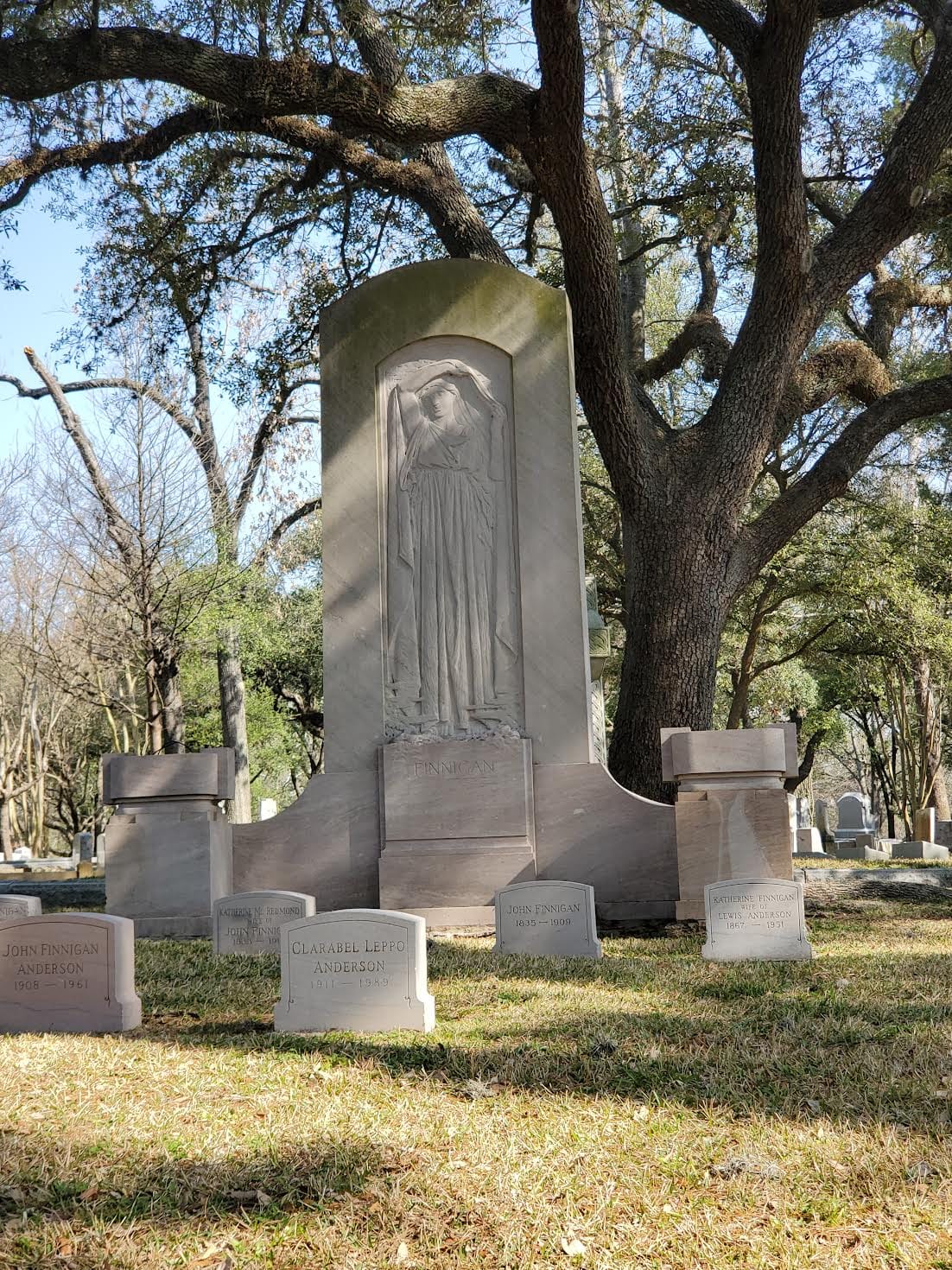
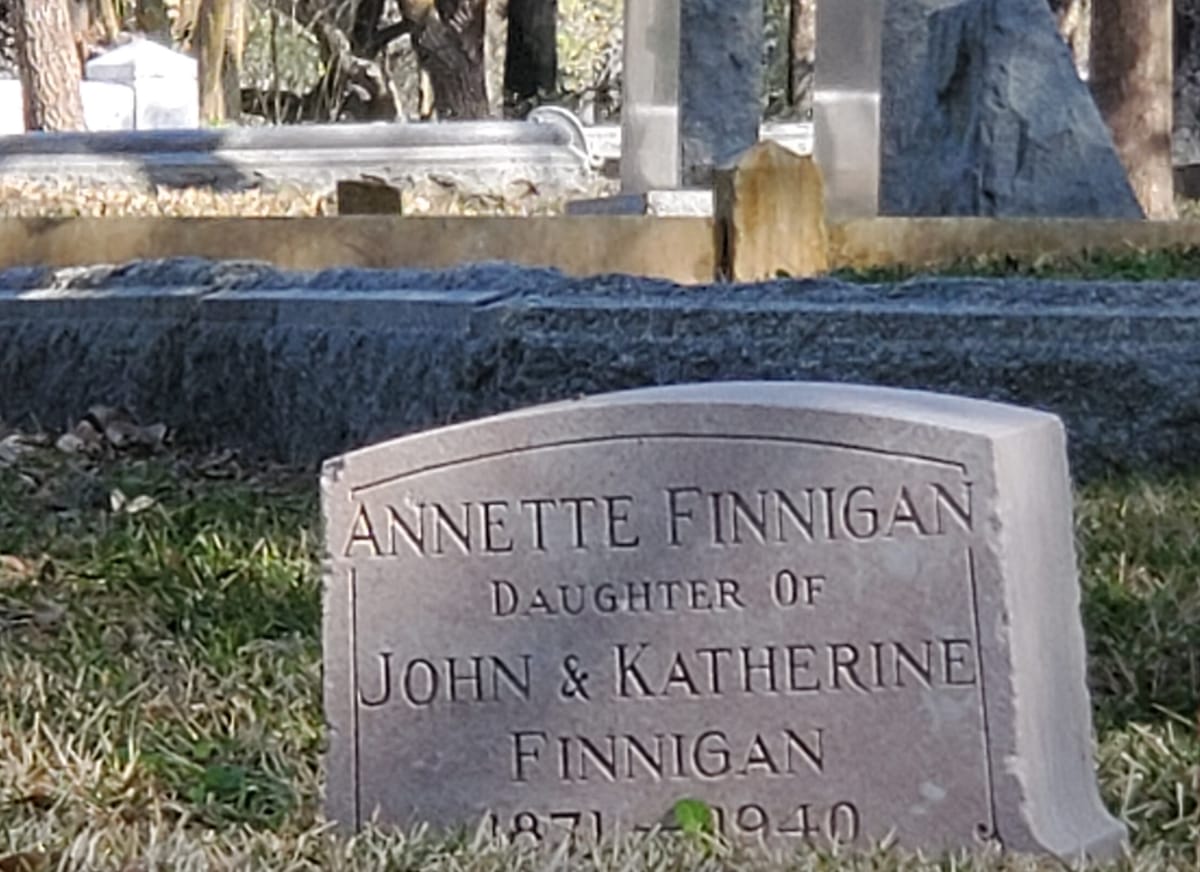
The Finnegan Family plot is like something out of a fairy tale. A twenty-foot bass relief of a woman looms over a small collection of graves. In certain light, the shadow of the woman’s veil covers her face as if she is in mourning. One tombstone belongs to the remarkable Annette Finnegan, who fought hard for women’s suffrage in Texas. Born in 1873, she moved to Houston when she was three. Her father, John Finnegan, was a wealthy businessman who believed that his three daughters should receive the same education as men.
“This was a time when women, especially upper-class women, were just expected to go to school for a while, marry the most eligible man that they could find, and then become housewives, essentially,” said Parsons. “John didn't want his daughters to feel like they had to do that. He encouraged them to think that anything was possible.”
Finnegan attended Tilden Seminary in New Hampshire, graduated from there, then graduated from Wellesley College in Massachusetts in 1894. She enrolled in post-grad studies at Columbia University in New York at Barnard College, the women's arm of Columbia. When her father died, she returned to Houston in 1903 to take over his business.
She and her sisters established the Texas Equal Suffrage League, one of the first organizations in the lone star state to call for women’s voting rights in the twentieth century. Though there had been earlier organizations dedicated to suffrage, the Texas Equal Suffrage League was in a class of its own.
Finnegan was an effective trailblazer, leading a statewide group of women to lobby the legislature for a resolution for equal voting rights. The vote was 90 in favor and 32 against, which was a strong show of support, but not quite enough.
“They came really close and they actually paved the way for the group that was successful in getting women the vote a little bit later,” said Parsons. Finnegan’s organization eventually became the Texas League of Women Voters, who still advocate for women in democracy today.
Finnegan is not the only prominent suffragette to be buried in Glenwood. Florence M. Sterling’s grave could be considered less opulent than Finnegan’s, just a simple flat headstone in the family plot. But that shouldn’t diminish Sterling’s impact on the state.
Florence’s father, Benjamin Franklin Sterling, owned a store in Houston and, when she was old enough, became his bookkeeper. Eventually, Benjamin Sterling started Humble Oil, which became Exxon, one of the largest oil companies on Earth. Florence Sterling was there with him, serving as full treasurer and secretary. She dedicated herself to women’s rights, and she was elected the second vice-president of the Texas branch of the National Woman's Party in 1916 as the Nineteenth Amendment gained support. When the Texas branch of the congressional union for woman's suffrage went to lobby for the amendment, she was there.
Even after the eventual passage of the Nineteenth Amendment, Sterling continued unabated. She founded the magazine Woman's Viewpoint in 1923. “No man on Earth can give a woman’s viewpoint,” she said upon establishing the publication, and spent her life until her death in 1940 making sure there were outlets for those voices.
Glenwood is a remarkable cemetery, well worth an afternoon stroll or taking one of Preservation Houston’s quarterly themed tours. Though there are movie stars, politicians, and entrepreneurs a-plenty, it’s also home to women who shaped Houston. You could spend days there researching headstones and not cover every woman who improved the city through hard work and civic mindedness.

Comments ()