
H1-B Visas Halted for Texas Teachers
Over the summer, Governor Abbott called for a law that would bar H-1B visa holders from working in Texas public schools

On January 27, Governor Greg Abbott directed state agencies and public universities to halt filing visas reserved for highly skilled workers without written permission from the Texas Workforce Commission until May 31 of next year. He cited “recent reports of abuse” in the federal H1-B visa program as the reason for the freeze.
He also demanded they report the number of visa holders and their roles.
Visas like H1-B, have critics across ideological lines, including liberal think tanks like the Economic Policy Institute. But it’s the Republican Party currently, led by President Donald Trump, who have recently heavily scrutinized the program.
“The economy of Texas should work for the benefit of Texas workers and Texas employers,” Abbott said.
In their reports to the Texas Workforce Commission, 44 public universities health centers and system offices reported sponsoring 3,332 H-1B workers. Under Abbott’s order, agencies need the commission’s written permission to file new petitions and must send it their H-1B reports.
Texas employers won approval for more than 41,000 H-1B petitions in fiscal 2025, according to U.S. Citizenship and Immigration Services. That is less than 0.3 percent of the state’s 15.2 million working Texans.
Austin immigration attorney Jason Finkelman compared attacking the program to shooting yourself in the foot, and said public universities badly need highly skilled researchers and professors.
Jobs “funded with taxpayer dollars” should go to Texans first, Abbott wrote in his letter. Yet the freeze does not touch the companies the state hires, and some of the country’s heaviest H-1B users hold large Texas contracts, a KXAN investigation found. Deloitte Consulting ranked 10th nationally in H-1B approvals in fiscal 2025, according to USCIS.
Early this year, Deloitte and its subsidiaries held more than two dozen state contracts worth over $2.12 billion. Oracle America, ranked 13th, held more than 50 contracts worth over $268 million, and Capgemini America, ranked 17th, held more than $460 million. The state does not track how many H-1B workers are on those contracts. Abbott’s office did not answer KXAN’s questions about whether he would restrict them.
Chelsie Kramer, Texas state organizer for the American Immigration Council, said while the freeze applies to fewer than one in 12 H-1B workers in Texas, “it is just as important to look at who is actually included in that small percentage.”
It’s also too broad, she said. There are documented cases of abuse in the program, she noted, and employers who commit fraud should be held accountable. “Using a broad freeze to address specific problems is a little like using an axe where a scalpel is needed,” she said.
On August 18, Abbott called for a law that would bar H-1B visa holders from working in Texas public schools. He announced it at a news conference at the Texas Public Policy Foundation in Austin. The ban would apply to current employees as well as new applicants.
He told reporters, “I don't see any reason why we need any H-1B visa employees in our public schools in the state of Texas. But we're going to find out if there's some unique skill set or whatever the case may be.”
Should the legislature pass it next year, Texas would be the first in the country to bar public schools from sponsoring via holders.
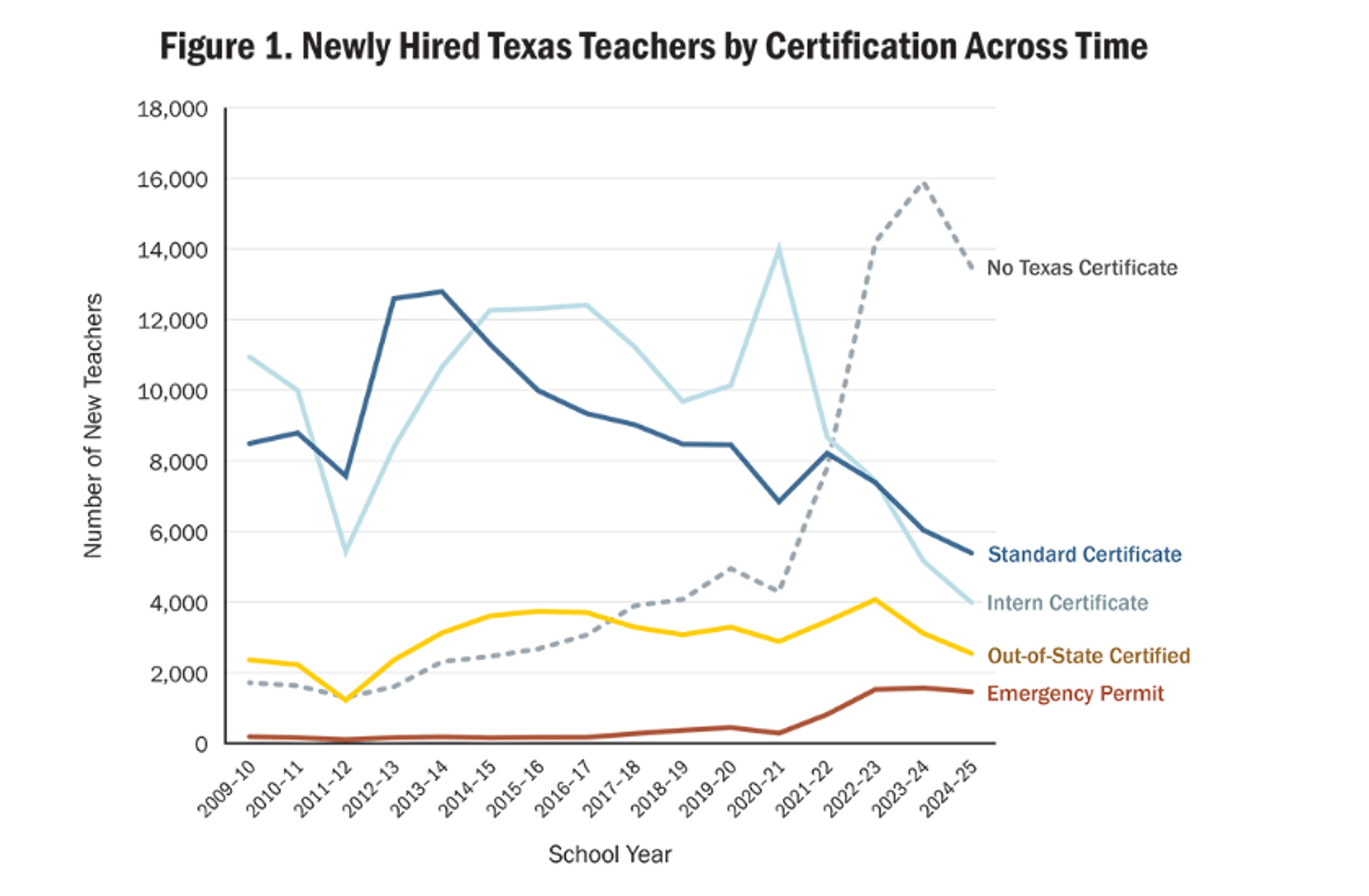
Federal data shows 337 H-1B visa holders working at Texas public school districts, KXAN reported, roughly 0.11 percent of the state’s teachers.
Dallas ISD has more employees on H-1B visas than any other school district in the country. Between July 31, 2025, and June 30, 2026, the district had 171 H-1B applications approved for new hires and renewals. That count leaves out foreign employees whose visas were not up for renewal. Among Texas districts, Houston ISD is second with 30, the Houston Chronicle reported.
“We only hire teachers from abroad to fill critical shortages identified by the Texas Education Agency, and each of these teachers is certified by the TEA as well,” Dallas ISD said in a statement. “If the governor’s new expectation is to eliminate these teachers, then we’re going to need more Texans in the teaching pipeline.”
Alief ISD in Houston employs 17 people on H-1B visas. They teach dual language, bilingual special education and special education, fields where it finds few certified local candidates. In a statement a spokesperson said, “The district uses H-1B visas to recruit and retain qualified educators in areas where there is a limited supply of certified candidates in the local labor market.”
Uncertified teachers aren’t confined to Alief or Dallas. It’s a statewide problem for public schools.
Texas had 42,103 uncertified teachers in 2024-25. The share of uncertified teachers tripled in five years, from 3.8 percent in 2019-20 to 12 percent in 2024-25. New hires without certification went from 2,462 in 2014-15 to 13,486 in 2024-25.


Comments ()