
Local ICE Partnerships Spur Uptick In Enforcement
“We are seeing much more aggressive coordination between local law enforcement and ICE than we have ever seen before"

Texas has been amping up law enforcement's role in immigration since 2015, when legislators pushed the so-called “sanctuary-city ban.” It failed that session, but a version passed in 2017, and it set up Senate Bill 8. Senate Bill 8, which Governor Greg Abbott signed in June 2025, requires sheriffs to enter a 287(g) agreement with Immigration and Customs Enforcement by December 1 of this year.
By mid-May, ICE counted 380 active 287(g) agreements with Texas law enforcement agencies. 274 of them were with county sheriffs' offices, and according to an analysis of the ICE list, updated in April, found participating agencies in 186 of the state's 254 counties.
According to the monthly report from the Texas Commission on Jail Standards, county jails held roughly 7,275 inmates for ICE in May and 5,029 were still confined when the month closed. The other 2,246 had been released or transferred to ICE. The monthly figure has fallen in seven of the nine months since its peak of more than 8,200 last August.
More than 7,300 people a month, on average, spent time this spring in a Texas county jail with an ICE detainer on file. Since February, the number of inmates has been lower than last year, and the difference grew from 85 to 566 in May. In the last 4.5 years covered by this report, the count never stayed below last year’s level for more than a single month.
Where The Holds Moved
Krishnaveni Gundu, co-founder and executive director of the Texas Jail Project, an advocacy group that works with people held in county jails, told the Texas Signal that the numbers match what the group sees.
“We are seeing much more aggressive coordination between local law enforcement and ICE than we have ever seen before,” Gundu said.
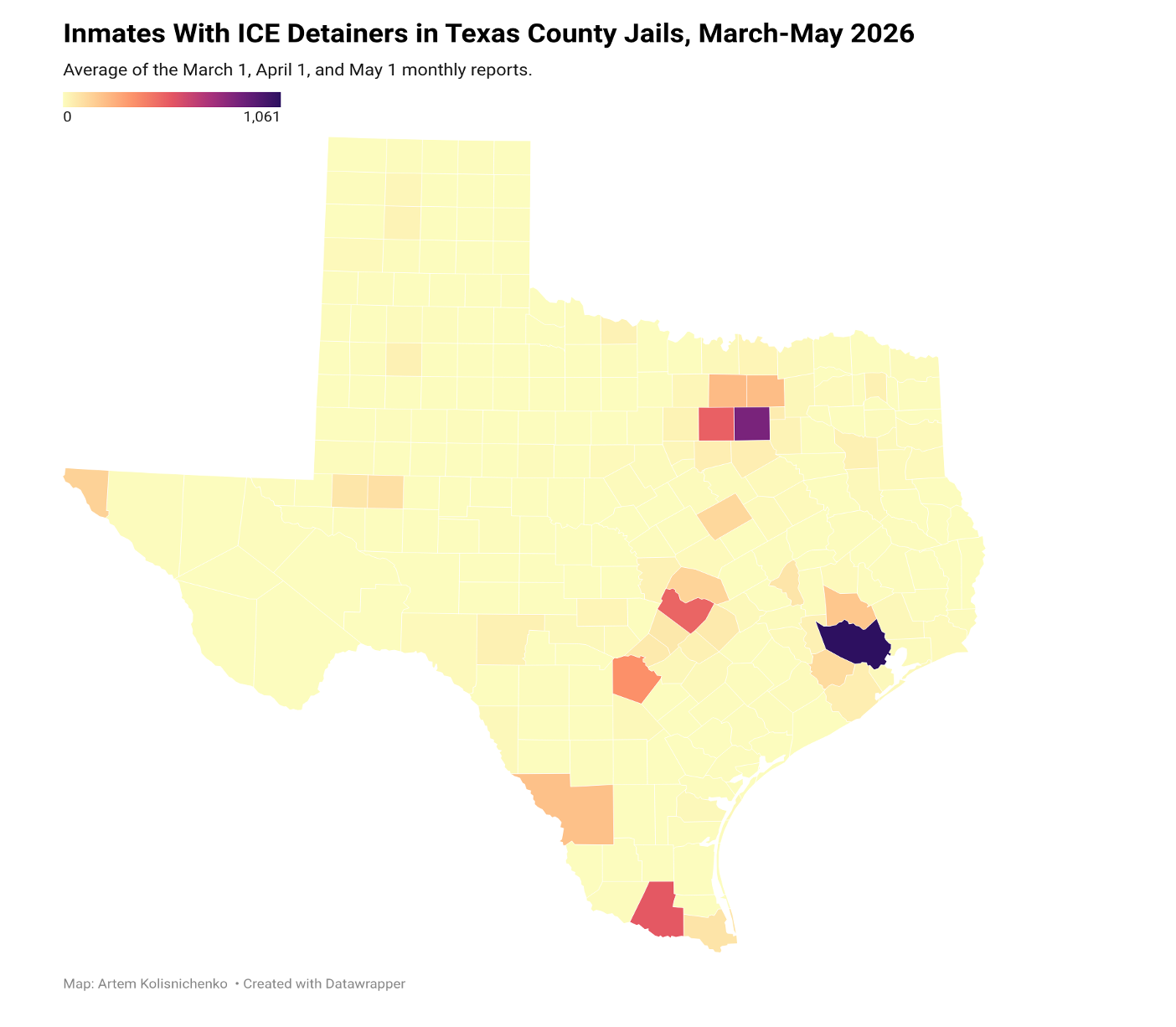
Between the December through February reports and the March through May report, the statewide count barely moved, but detention in midsize counties like McLennan and Midland rose by nearly a third.
Holds can rise while the count stands still because a detainer is a request on file, not a person in a cell. In May, 2,246 inmates with detainers left county jails statewide, through release or transfer to ICE, while 2,227 came in.
Five counties – Harris, Dallas, Tarrant, Hidalgo, and Travis – account for just over half of all inmates held in a Texas jail on a detainer. Harris County posted the largest decline in the state, yet still holds the most of any, at nearly 1,300 inmates with a detainer in an average month. On the border, the numbers decreased or stayed flat. Hidalgo and Cameron barely changed. El Paso fell, and Webb County was the only border county of any size to rise.
Last December, McLennan County's sheriff's office’s 287(g) agreement chose the task force model, allowing deputies to ask about and arrest someone based on their immigration status during routine daily enforcement activities like traffic stops.
McLennan County Sheriff Parnell McNamara said bluntly of this agreement that deputies who encounter someone they believe is in the country illegally during a normal day’s work “just detain them and call ICE.”
The result? In the last quarter, McLennan more than doubled its new detainer placements, and its average detainer population rose by nearly a third.
What El Paso Shows
El Paso is the border county to watch. What happens there shows how the system itself is shifting, even as the mid-sized counties grow. Documents obtained by the Texas Signal through an open records request show how long detainees are held. A detainer asks a jail to keep a person up to 48 hours past the point it would otherwise release them, so ICE can take custody. The detainer carries no criminal charge of its own, so for someone held on local charges it does nothing until their case ends, and it can sit on the file as long as that case keeps them in jail. At the end of May, 58 of the county's 157 inmates with a detainer had been carrying one since before this year. 22 had been in jail more than a year. One had been held for 1,088 days.
People held for extended periods “are not being held that long simply because they have an immigration detainer, they are being held on their criminal charges,” Gundu said. Once a person pays bond, ICE has 48 hours to take custody or the jail must let the person go. 48 hours may not seem like 1,088 days, but the wait damages people either way.
“Any length of time spent pretrial in a county jail is extremely disruptive and destabilizing to individuals, their families and communities…People lose their jobs, their cars, their homes, their families, their kids,” Gundu said.
Not every county is like El Paso. But some are acting similarly.
In Harris County, ICE officers are stationed inside the jail at all times with a designated workstation and desk,” Gundu said, a presence a jail sergeant confirmed during a tour Gundu took last year. The setup “makes the transfer to ICE seamless and fast,” she said. “We have never been able to secure anyone’s release in Harris County based on that 48 hour clock. It’s a well-greased deportation pipeline in the bigger counties.”
What The Holds Cost
The state keeps a price sheet for all of this. Counties reported $46.4 million in detainer holding costs for March through May, with each month’s cost roughly averaging $15,395,000, for a statewide average of $97.17 per inmate per day. El Paso reports a flat $134 per inmate per day, following the formula the state prescribes.
Sheriffs who call 287(g) a revenue stream “have done a great job gaslighting the public on what exactly the funding is meant for,” said Gundu. In reality, they’re only paying to deputize local law enforcement officers for immigration enforcement, not to hold the detainees.
“County governments are still on the hook for any and all pretrial detainees who are held in our county jails irrespective of immigration status,” Gundu said.
This unfunded mandate comes at a time when counties across the state are slashing their budgets. Despite making the argument about the sky high costs to cash strapped counties, she said, “the cost argument has failed with county commissioners.” That’s even before the state made the agreements mandatory.
Senate Bill 8 pairs its mandate with state grants of $80,000 to $140,000, depending on county population, to offset participation costs, and some jails separately collect a per-inmate daily rate for housing federal prisoners under contracts with agencies like the U.S. Marshals Service.



Comments ()