
Prisoners Sent Out Of State, Left Out Of The Count
Despite the alarming number of deaths and high cost to send inmates out of state, Harris County keeps sending people anyway

For years, the solution for many crowded jails in Texas was simple: send inmates out of state. And a convoluted reporting system means it’s almost impossible to fully track how many of these inmates die out of state.
To transfer the average 1,100 inmates a month from Texas to out-of-state jails, officials simply sign the transfer paperwork and pay a daily fee to temporarily house them. That fee may be their only reminder about the inmate.
But if they die across state lines, they might as well have never existed. That’s because there’s no state reporting requirement for when an inmate dies out of state. It’s something prison reform, transparency activists concern and state legislators have addressed, but faced legislative deadlines and sometimes hostile responses to calls for change.
“Thanks to legal loopholes, [Texas] does not technically have to report these deaths despite being fully complicit in them,” Krishnaveni Gundu, wrote to Brandon Wood, then the executive director of the Texas Commission on Jail Standards, in December 2024. Gundu is the co-founder and executive director of the Texas Jail Project, an advocacy group that works with the incarcerated.
And there’s more: their deaths may not even be appropriately documented. That’s because the numbers documented by State Commission of Jail Standards and Attorney General’s office, the two agencies that track jail deaths, don’t even match.
From the beginning of the year through the end of May, the in-custody death log kept by the commission counted 57 deaths among inmates in county jails. But the attorney general’s office public database that also tracks jail deaths only reported 48 deaths.
Gundu has asked that out-of-state deaths be reported to the attorney general’s office but was told no legal mechanism exists to do it for a death outside Texas. That’s unlike the report required for when a person dies inside a county jail, which lists a time, a place and a cause of death.
Brandon Wood, then the Commission’s executive director, admitted to a reporter in 2023 that once inmates leave the state, it loses much of its authority over them.
No name, no problem, at least in out-of-state jails
Gundu cited five cases where the databases don’t match each other, four of which involved inmates sent from Harris County to LaSalle Correctional Center in Olla, Louisiana, since 2022. They are:
Billie Davis, 35, who died from blunt-force injuries in a fight in 2022.
Jaleen Anderson, 29, died after multiple seizures that left him vomiting and unresponsive in 2024.
Erik Carlson, also 29, died of an untreated strep infection in 2025.
Tevin McClendon, 33, died there in March of this year after smoking an unknown substance.
The fifth man Thomas E. Marshall Jr., 48, was sent from Liberty County to the Phelps Correctional Center in Beauregard Parish, La., in September 2023. It is recorded as a suicide.
They were not documented in Louisiana either.
While states have a patchwork of laws involving reporting out-of-state jail deaths, federal law requires every state to report deaths in law enforcement custody. The Bureau of Justice Assistance, a branch of the U.S. Department of Justice that provides assistance to state and local law enforcement, released the 2020 through 2023 figures in November 2024.
Gundu said she had several experts comb through the data sets. Tables 3 through 6 break the deaths out by state and can be searched by name. Neither Davis nor Marshall was there.
“There’s nothing we can do to force [Louisiana] to report these deaths except to implore their [Attorney General], and inform the [Bureau of Justice Assistance],” she wrote to Wood.
Lots of money, lots of questions
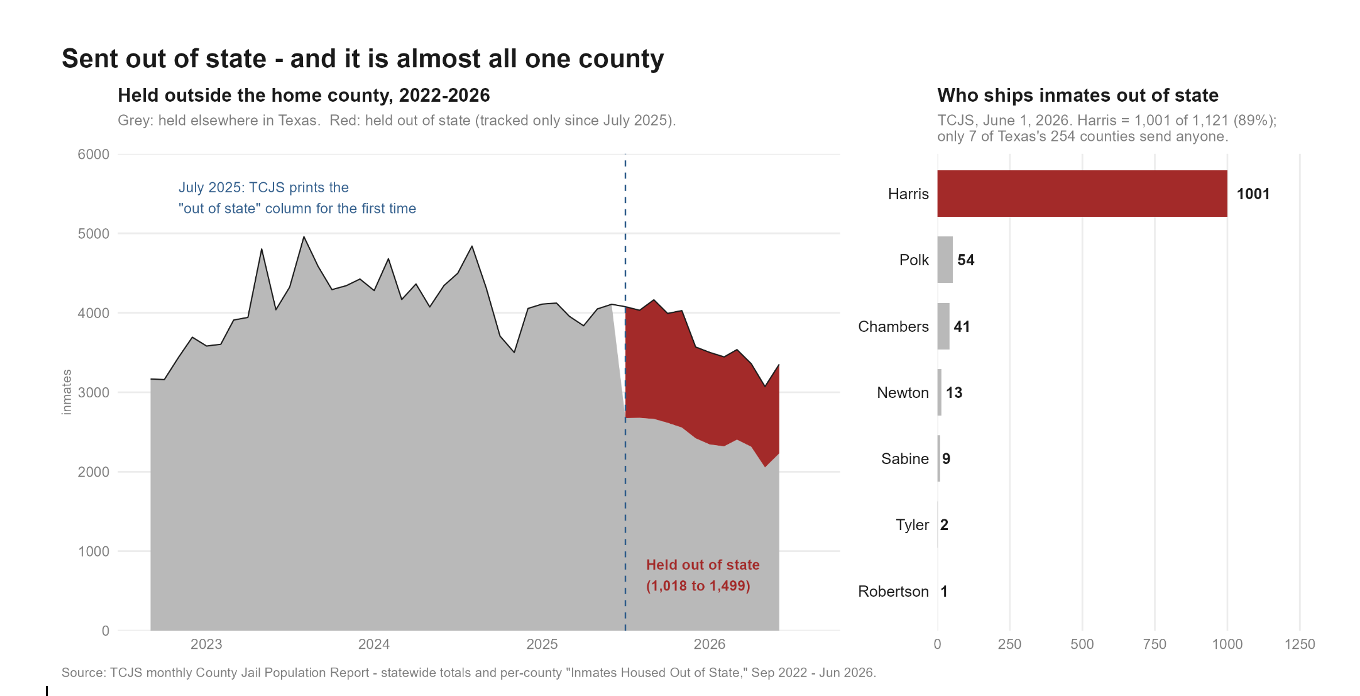
Despite the alarming number of deaths and high cost to send inmates out of state, Harris County keeps sending people anyway. This year commissioners approved a $38 million deal to keep the transfers running through 2027, over the objections of the mothers of the men who died. Until last year, the county also had a contract with a Mississippi jail. The county ended that contract citing budget issues. But the county’s own budget director calls outsourcing the single most expensive thing it does, and still maintains a contract with LaSalle Corrections, which by its own count runs 18 jails and detention centers in Louisiana, Texas and Georgia.
Harris defendants sent to Olla have reported extortion and threats of violence. When a lawyer asked a judge to spare one client the trip back, the county argued he was no safer at home: “things happen every day in that jail,” its own attorney said of the Houston lockup.
Progress and setbacks
Sarah Knight, Jaleen's mother, has spoken at almost every quarterly meeting of the State Commission on Jail Standards since her son died in April 2024. Kim Carlson Lewis, Erik's mother, joined her, speaking at the commission's August 2025 meeting and again in November.
“Jaleen and all the others were counted over and over again for all sorts of reports when they were in jail…they deserve to be counted in death as well,” Anderson’s mother said during one meeting.
In late 2024 Gundu was appointed to the commission's Administrative Rules Advisory Committee, where she sits with sheriffs, jailers and county officials as the only advocate with a vote. Her argument there was about escapes.
"When TCJS compiles population reports, what do you do in a scenario where a county shipped out let's say 300 people and only 298 come back because two escaped?" Gundu recalled asking the committee. "You would have to record that somewhere right? So why not do the same for deaths? I just want them somewhere so we have a measure of one of the worst outcomes of pretrial detention."
The commissioners listened. After hearing about the deaths, the commission issued a technical assistance memo directing county jails to report deaths in out-of-state facilities, including on those who died before the change. They, however, are still not required to investigate the deaths.
That’s a good start to Gundu. But not enough.
“A count is just the first step,” Gundu said. “But we still lack the mechanism to meaningfully investigate these deaths and hold anyone accountable. We believe outsourcing of pretrial detainees should be illegal.”
The fix that passed the Senate and died in the House
In the 2025 session, three bills tried to close the transparency gap. Senate Bill 2289, filed by Sen. Borris Miles, D-Houston, would have required jails to report how many inmates they hold out of state and how many die there. It passed the Senate 28 to 2, with only two Republicans, Sen. Donna Campbell of New Braunfels and Attorney General nominee Mayes Middleton of Galveston, voting no. But it died in a House committee before it could get a hearing.
Two others died in committee.
Senate Bill 2263 by Sen. Molly Cook, D-Houston, would have required a justice of the peace to investigate out-of-state deaths, died in the Senate Criminal Justice Committee without a hearing. House Bill 4642 by Rep. Mary González, D-El Paso, which would have held the out-of-state jails to Texas standards, passed the House Intergovernmental Affairs Committee but died before it could get a full vote in the House.
With none of the three became law, advocates hope they can get those bills to governor’s desk. But the legislature doesn’t meet until which starts in January 2027.


Comments ()