Rothko Chapel’s Broken Obelisk Still Symbolizes MLK’s Dream
February 28 marks 55 years since Broken Obelisk was put on the Rothko Chapel grounds, quickly becoming one of the city’s most famous landmarks. The Chapel will be celebrating with a variety of speakers, events, and activities
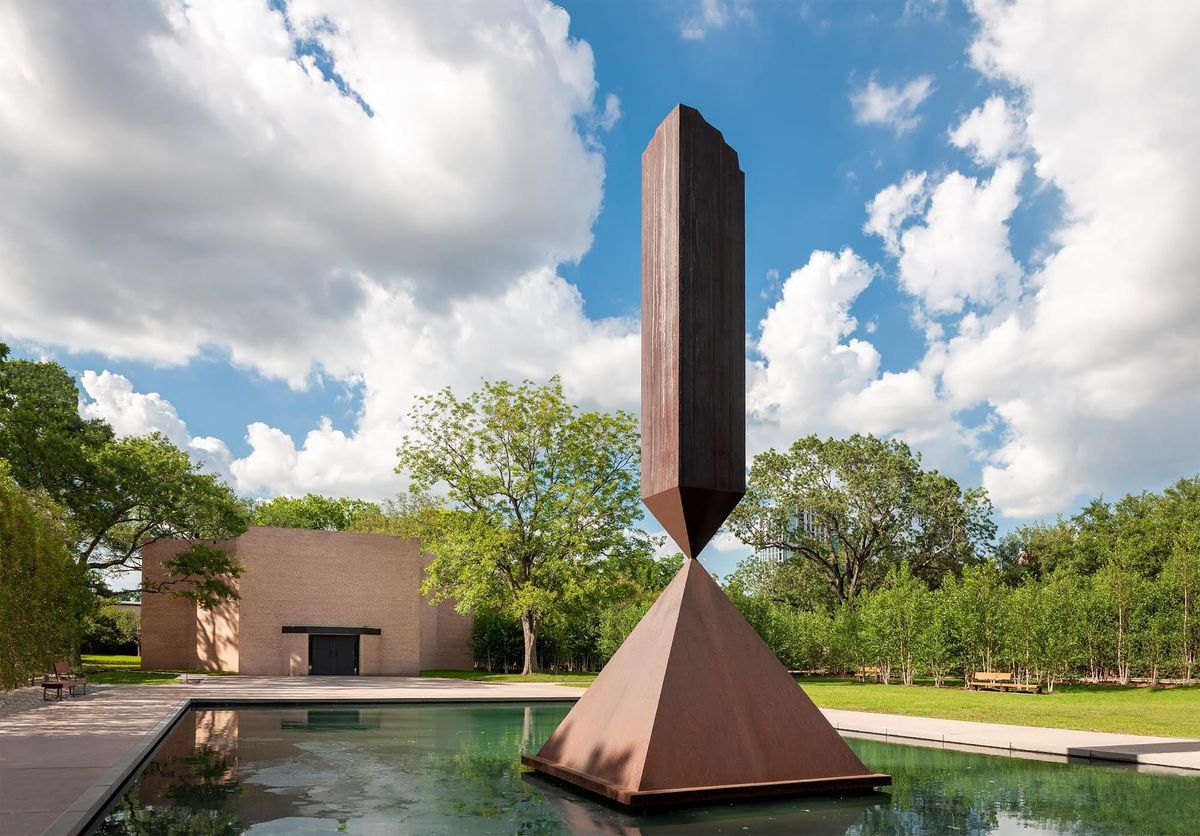
In 1971, Dominique de Menil stood in front of a small crowd outside the newly opened Rothko Chapel. Dressed in somber black, she delivered a touching eulogy to the late Rev. Dr. Martin Luther King Jr., felled by an assassin’s bullet just three years earlier and cutting short the career of one of America’s most impactful civil rights leaders.
To Menil’s right, installed in a crystal-clear reflecting pond, was her latest, permanent artistic contribution to her adopted city of Houston, and perhaps her most enduring: the sculpture Broken Obelisk by Barnett Newman. Menil, who had fled Nazi-occupied Paris with her husband, John, had a keen interest in King’s vision of an equal world. She addressed the crowd as she dedicated the sculpture to him.
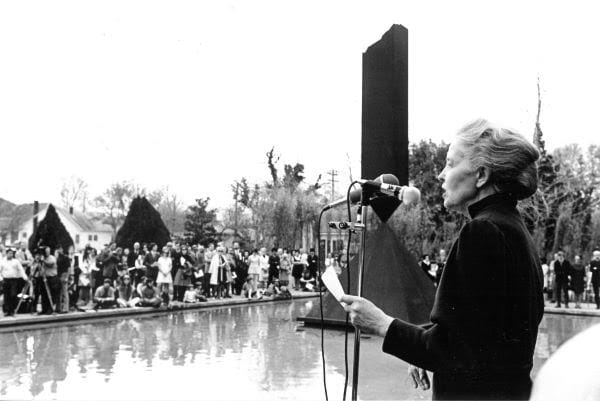
“As you know, books and art objects are often given to a library or a museum in memory of a friend,” she said. “Having a profound admiration for the late Dr. Martin Luther King Jr. and wanting to honor him, John and I are giving this sculpture in his memory to the citizens of Houston. We have here both a chapel and a monument, a place for worship and a memorial to a great leader. The association of these two remarkable sites should tell us over and over again that spiritual life and active life should remain united. It should tell us over and over again that whoever believes he loves God and does not love his neighbor is deceiving himself. It should remind us over and over again that there is no love without justice.”
February 28 marks 55 years since Broken Obelisk was put on the Rothko Chapel grounds, quickly becoming one of the city’s most famous landmarks. The Chapel will be celebrating with a variety of speakers, events, and activities noted on their website. These days, such an honor for King seems little more than a formality, but Menil had a terrible time when she first tried to install the sculpture. She and John were able to use a federal art grant to help secure it, but city leaders balked at having a sculpture dedicated to King outside City Hall. Today King may be a beloved founding father of post-Jim Crow America, but in 1971 many still sneered his name as a terrorist and a communist.
“Mayor Louie Welch knew right off the bat that it would never go through,” said Carolyn King, visitor engagement specialist at the Rothko Chapel, during a phone interview. “In 1968, city fathers were all white, all male, very against the civil disobedience of Dr. King. But for the Menils, this was something that needed to be done, come what may.”
Eventually, the Menils opted to purchase the sculpture outright and establish it at Rothko. King himself would probably be pleased. The chapel is Houston’s preeminent non-denominational space for prayer, meditation, and contemplation. It is above all else a free community center where anyone can visit and no one is excluded.
Over the years, the Broken Obelisk has only grown in its connection to King. One could look at it as a representing the delicate balance of civil rights, with the broken top of the obelisk a powerful metaphor for how King died with his work still unfinished. Powerful, black and elegant, it mirrors both the myth and reality of the man it is dedicated to.
“We can make this be symbolic of a life cut short or a dream deferred,” said Carolyn King. “You know, to get into the kind of construction of the actual obelisk, the place where the tip, the apex of the pyramid and the apex of the obelisk itself, they're not welded together. They are literally balancing on each other. It really is this precarious balance of ‘do we allow injustices to become the normalization, or do we pick up the mantle? Do we continue this just fight, this just cause?’ I think that's a tightrope that some folks struggle with, and so it's a perfect spot for it to sit outside the chapel this reminder.”
Perhaps the greatest testament to King from the sculpture is its endurance. Over the past half century, it has been defaced numerous times. In 2018, someone splashed it with white paint and left flyers saying “it’s okay to be white” all over the campus, a now-typical alt-right and neo-Nazi slogan that grew out of Chan board culture.
Each attack has been cleaned up as if it never happened. Broken Obelisk is made of Cor-Ten steel, The material has a unique quality that makes it self-healing, with the rust and weathering forming a protective layer. Petty crime has virtually no effect on it aside from an afternoon of cleanup. This, more than anything, shows the power of the Menil’s gift and genius in dedicating Broken Obelisk to King. All the principal players may be gone now, but it still stands as an active reminder of humanity’s better nature.
“The structure envelops itself, cocoons itself and protects itself,” said King. “Folks can try and deface it, try and promote bigotry as often as they want, but the sculpture and the folks that surround the chapel will really, I think, take care of itself in a metaphorical but also literal way.”

Comments ()