
Texas Cities Targeted Over ICE Guidelines
Abbott and Paxton took coordinated action against Houston, Austin, and Dallas over local policies that restrict how municipal police cooperate with Immigration and Customs Enforcement

This past month, three major cities in Texas came under fire from the Governor and the Attorney General over immigration enforcement. Governor Abbott and AG Paxton took coordinated action against Houston, Austin, and Dallas over local policies that restrict how municipal police cooperate with Immigration and Customs Enforcement.
On Monday, April 13, Abbott’s office sent a letter to Houston threatening to pull about $110 million in public safety grants. On Thursday, April 16, the governor’s office sent similar letters to Austin and Dallas. Austin could lose about $2.5 million. Dallas could lose more than $32 million in grants, plus up to $55 million tied to the 2026 FIFA World Cup. The total losses for all three cities are over $200 million.
In this same time period, Paxton filed a lawsuit against Houston in Fort Bend County, not in Houston’s home county of Harris, over the ordinance that restricts ICE activity. The suit names Mayor John Whitmire, every city council member, and Police Chief J. Noe Diaz. Paxton also opened an investigation into the Austin Police Department’s immigration policy. It is not known whether Dallas faces a similar investigation; Paxton’s office did not respond to the Texas Tribune’s request for comment.
“I will not allow any local official to push sanctuary policies that make our communities less safe,” Paxton said. “Under my watch, no Texas city will be a safe harbor for illegals.”
Senate Bill 4, 2017
On May 7, 2017, Governor Abbott signed Senate Bill 4. The law bans “sanctuary city” policies in Texas. The core provision sits in Texas Government Code Section 752.053. Cities cannot adopt, enforce, or endorse a policy that prohibits or “materially limits” the enforcement of immigration laws. Civil fines for a first violation range from $1,000 to $1,500. For each subsequent violation, they run from $25,000 to $25,500 per day a violation continues.
Sheriffs and police chiefs who knowingly refuse an ICE detainer request face a Class A misdemeanor. After that, the Attorney General must file a petition to remove elected officials who violate the law.
On August 30, 2017, U.S. District Judge Orlando Garcia blocked several key parts of SB 4 from taking effect. He called the “materially limits” language too vague and said the ICE detainer mandate violated the Fourth Amendment.
On March 13, 2018, the Fifth Circuit Court of Appeals reversed most of Garcia’s ruling. The court found that “with one exception, SB 4’s provisions do not, on their face, violate the Constitution.”
Austin, January 2026
On January 5, 2026, Austin Police officers responded to a disturbance call in southwest Austin. There they found Karen Guadalupe Gutierrez Castellanos, who had an ICE administrative warrant from 2019. Officers called ICE. Federal agents arrived and took custody of Gutierrez Castellanos and her 5-year-old daughter, Genesis Ester.
Genesis was born in the United States. The mother’s 2019 deportation order predated her daughter’s birth in 2020. Gutierrez Castellanos had a pending U-visa application, a status available to non-citizen victims of crimes, including domestic violence. They were held for nearly a week at an ICE-contracted hotel in San Antonio and deported to Honduras on January 11, 2026.
On March 4, 2026, the Austin Police issued new general orders. Officers can no longer arrest or detain a person based only on an ICE administrative warrant. They cannot stretch out a stop to wait for ICE. If a warrant shows up, the officer must call a supervisor. The supervisor can refuse the ICE request if it is “not reasonable or necessary.”
City Manager T.C. Broadnax told council the federal government had added more than 700,000 ICE administrative warrants to the National Crime Information Center in early 2025. That is the database local police check during every traffic stop. Unlike criminal warrants, administrative warrants carry no judicial sign-off and do not require local police to hold anyone.
Houston, April 2026
In Houston, the dispute about immigration enforcement moved into City Council proceedings. In March 2026, Houston Police Chief J. Noe Diaz and Mayor John Whitmire announced that officers would wait up to 30 minutes for ICE to arrive when an administrative warrant came up during a stop.
Three council members led the push to go further: Alejandra Salinas, Abbie Kamin, and Edward Pollard. All three are attorneys. They invoked “Proposition A,” a 2023 amendment to the city charter that allows any three council members to place items on the agenda without the mayor’s approval. It was the first time “Proposition A” had been used to override the mayor on a major policy issue.
On April 8, 2026, the council voted 12 to 5 to pass Section 34-41 of the city code. The ordinance ended the 30-minute wait rule. It banned officers from detaining or stopping anyone based on a civil immigration warrant. It required HPD to send each council member a public quarterly report on every use of city resources for immigration enforcement, including the ZIP code, the race and ethnicity of the person, the reason for the ICE contact, the number of officers involved, and the officers’ employee numbers. Whitmire voted for the ordinance.
Before the vote, City Attorney Arturo Michel removed one provision from the draft. The earlier version said officers “are not required” to call ICE. Michel told the council that the provision would violate SB 4 and could trigger removal of elected officials from office. It was dropped. Houston officers still have to call ICE on every warrant. But they can no longer hold someone past the time needed for the original stop.
Two days later, Paxton opened an investigation. He pointed to the removal provision in SB 4. “It’s a ‘shall’ be removed from office,” Paxton said. “It’s not up to me to decide.”
$110 million frozen, $114 million at stake
On Monday, April 13, Whitmire got a letter from Andrew Friedrichs, the executive director of the Governor’s Public Safety Office. Friedrichs said the new ordinance broke the grant certification Houston had signed. That certification promised the city would “participate fully” with the Department of Homeland Security. The letter gave Houston until April 20 to repeal the ordinance or start paying back $110 million. Whitmire called it a “crisis situation.” He said state funding was cut off that afternoon.
Abbott’s press secretary Andrew Mahaleris added more. “As of now, future funding is on hold,” he told the Texas Tribune. “If the City refuses to pay, the Texas Comptroller is required to deny the payment of any funds to Houston until the debt is paid.”
On April 15, Salinas sent Whitmire and Michel a formal letter demanding they file a temporary restraining order and challenge the state in court. U.S. Senator John Cornyn, who is in a May 26 runoff against Paxton for the Republican Senate nomination, posted on social media that “The Houston City Council’s new sanctuary city policy is not only absurd - it’s dangerous. Immigration enforcement is a critical part of ensuring national security and public safety...”
On April 16, Paxton filed the Houston lawsuit in Fort Bend County. The same day, Abbott’s office sent demand letters to Austin and Dallas, both with April 23 deadlines.
Whitmire canceled a special council meeting set for Friday, April 17, after Abbott extended the Houston deadline to April 22. At an April 16 press event in Houston, Abbott said: “The City of Houston right now is in breach of contract. We’ve given the opportunity to what’s called ‘cure’ that breach.”
Dallas
Dallas is on the list for a different reason: General Order 315.04.
It tells officers they cannot prolong a stop to check immigration status. They cannot stop a person “for the sole purpose of determining immigration status.” The order allows officers discretion on whether to call ICE.
At an October 14, 2025 meeting of the Community Police Oversight Board, Police Chief Daniel Comeaux disclosed that ICE had offered Dallas about $25 million to join the 287(g) Task Force Model. The program lets local officers perform certain immigration duties. Comeaux refused. “We said absolutely no, not no,” he said. “That was me who said that. Turned it down.” He added: “No one is going to be wearing a DPD uniform enforcing federal laws. It just won’t happen.”
On November 6, 2025, a joint committee of the Dallas City Council voted unanimously to indefinitely postpone any reconsideration of 287(g). Six months later, Dallas received Abbott’s letter.
Senate Bill 8 and 287(g)
In June 2025, Governor Abbott signed Senate Bill 8. The law requires sheriffs in every county that operates a jail or contracts with a private vendor to operate one, to request and, if offered, accept a 287(g) agreement with ICE. The attorney general’s enforcement authority and the compliance deadline apply specifically to counties with populations above 100,000. Three models exist: the Task Force Model (TFM), the Jail Enforcement Model (JEM), and the Warrant Service Officer (WSO) program. The compliance deadline is December 1, 2026.
On April 21, 2026, ICE’s 287(g) team sent a message to all partner agencies nationwide with the subject line “Prohibition on unilateral release of PII and other ICE data.” The email reminds sheriffs and police chiefs that under the 287(g) Memorandum of Agreement, any documents created by a local agency as a result of the MOA are “under the control of ICE,” including “all Personally Identifiable Information (PII) or 287(g) numbers, calculations, or statistics obtained by your agency.” The prohibition covers press conferences, press releases, media ride-alongs, social media posts, and responses to FOIA requests. As more Texas counties are pulled into 287(g), the question of what the public will be able to see about the program becomes central.
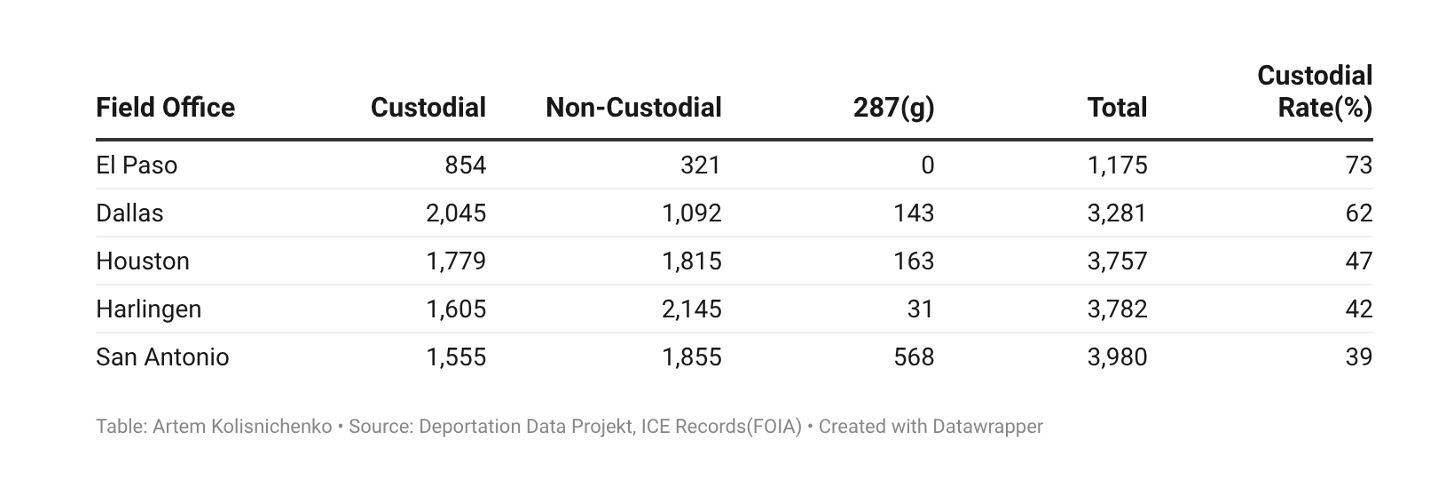
Even with that lid on local disclosure, the early picture is thin. As of Q1 2026, many participating counties had not completed training and had no arrests or bookings under their 287(g) agreements. ICE recorded 905 arrests across all Areas of Responsibility in Texas. San Antonio’s AOR accounted for 568 of those. Houston and Dallas AORs, which include many counties, remained at low levels, in part because the largest jurisdictions, Harris County and Dallas County continued to resist full cooperation.
$200 million in grants and World Cup funds at risk
Houston faces the biggest hit: about $110 million. The city is also carrying a projected $174 million budget deficit for fiscal year 2026, disputed by Whitmire. NRG Stadium, rebranded “Houston Stadium” for the World Cup, will host seven matches between June 14 and July 4, 2026.
Dallas stands to lose about $87 million, counting grants and World Cup security funding. AT&T Stadium in Arlington, which will be called “Dallas Stadium” during the tournament, will host nine matches, including a semifinal on July 14, 2026.
Austin’s $2.5 million is the smallest slice. But Watson said the money funds officer trauma response, support for sexual assault survivors, violent crimes against women programs, cybersecurity, terrorism preparedness, and mental health care for police. “There is great irony,” he said, “that the state would try to punish the City for providing services that keep Austinites safe by threatening grants that keep Austin safe.”
April 22 amendment, April 23 deadlines
On April 22, Houston’s council voted 13 to 4 to amend the ordinance. Under city rules, repealing an ordinance less than 90 days old required 12 of 17 votes; amending it required only nine.
The amendment kept Section 34-41 on the books but removed its sharpest language. It stripped the passage stating that ICE administrative warrants are “not reviewed by a neutral magistrate or judge” and do not constitute probable cause. It dropped the word “only” from the rule limiting how long officers can detain someone on a stop. It added that officers may extend a stop “for other legitimate purposes discovered during the detention.”
On April 23, Austin and Dallas faced their deadlines. Dallas spokesperson Rick Ericson said: “We remain committed to complying with all applicable state and federal laws while continuing to prioritize public safety for the residents of Dallas, and ensuring our officers have the resources and support necessary to effectively serve the community.”
Ultimately, Dallas and Austin followed in Houston's lead with amended policies regarding ICE.
Paxton’s lawsuit goes forward either way. The Fort Bend County venue gives the state a more conservative court than Harris County. The suit asks for both a temporary and a permanent injunction, plus protection for officers who cooperate with ICE.
Unlike SB4 fines, which must be adjudicated in court, the grant freeze is an administrative action that requires no judicial involvement. The cities signed the grant contracts themselves, and the Comptroller can hold the money on the governor’s say-so. Asked if a court could stop the freeze, City Attorney Michel told the council: "It’s at the governor’s discretion, so that is going to be difficult to have any court say the governor cannot exercise his discretion to either give the grant or not give the grant in any sense really."

Comments ()