Transforming Traumatic Brain Injuries Into Art
Tim Colomer's work has made him an unofficial artist-in-residence for the bomb squad community. He has even been invited to contribute to a large obelisk at the National Museum of the Marine Corp.
On December 11, 2006, Tim Colomer was in an armored vehicle when it ran over a bomb in the middle of the road. The gunnery sergeant and his team had spent weeks since their deployment to Iraq defusing improvised explosives, sometimes working 24-hours-days. He was good at his job, but on a long enough timeline, every possibility becomes a certainty.
The armor of the mine-resistant ambush protected vehicle (MRAPV) saved Colomer’s life, but he was seriously injured by the blast. He hit the roof of the vehicle so hard that his helmet split into two pieces like an egg, leaving him with a broken neck and traumatic brain injury (TBI). The Marines wanted to send Colomer home, but he recovered and remained with his team through 2007.
“I didn’t want to leave my Marines behind,” said Colomer in a phone interview. “I used my seniority to put my uniform on, take my IV’s out myself, and go run out to the flight line and jump on a helicopter and find my way back to my unit, which is what I did. I got in a good bit of trouble for it. A little bit of a hand slap as a senior Marine, but it is what it is.”
Colomer is tough, no doubt, but he was not well. Returning stateside, he began having severe neurological problems. His injuries left him prone to insomnia. He began to have trouble speaking, often losing common words such as “the” and “but.” Reading became impossible as the sentences would appear backwards.
After a lot of rehabilitation, Colomer enrolled in George Washington University, then eventually moved to Houston to work for Halliburton,and, in his own words, planned to keep his head down for the rest of his life. Then, in the holiday season of 2023, Colomer was taking his 10-year-old through Micheal’s while his wife did Christmas shopping in a clothing store next door. His son asked for a simple paint project set of Santa and, on a whim, Colomer bought one for himself.
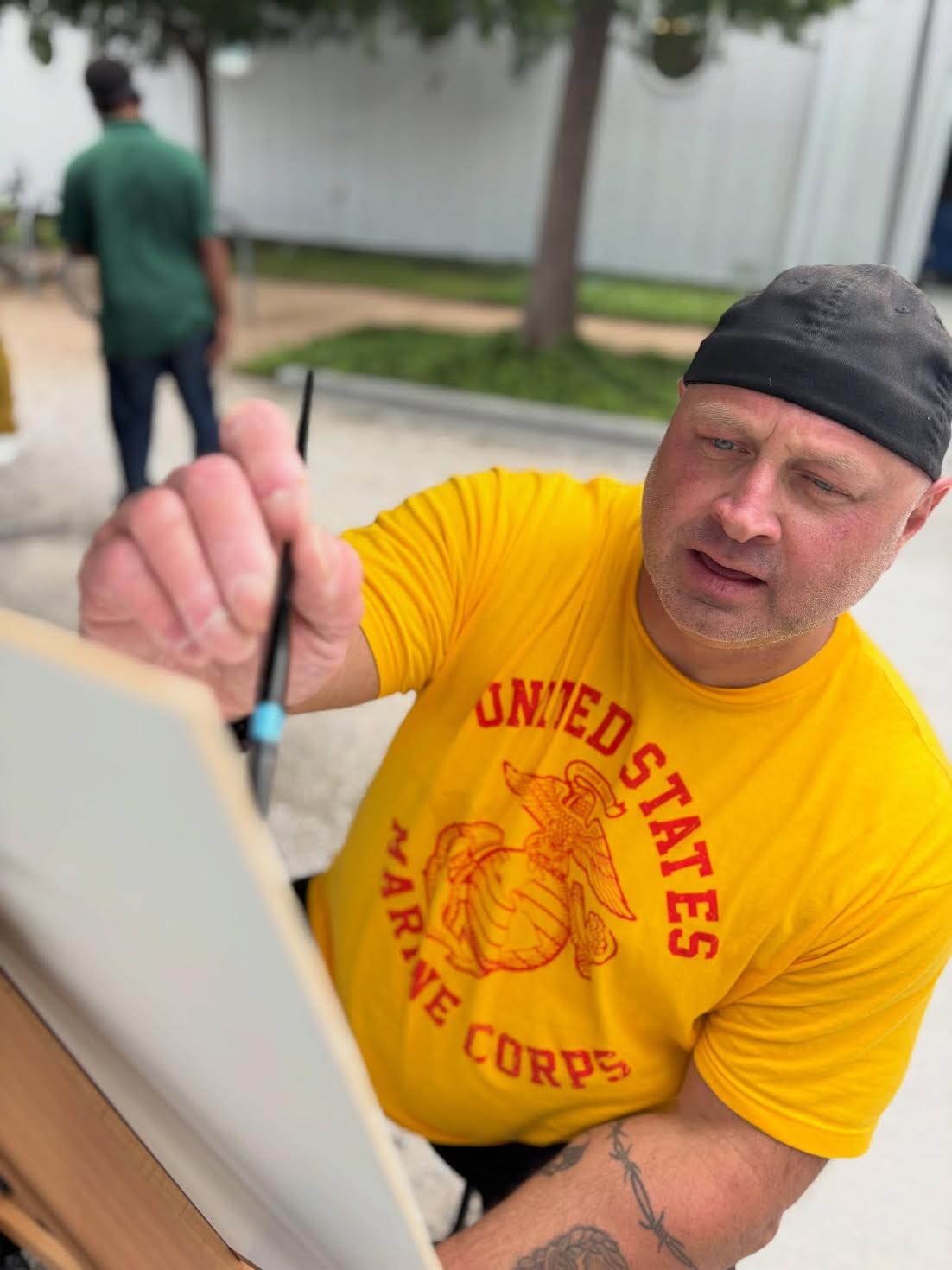
He was instantly hooked and discovered he had a talent for painting. Within a few months, he was painting his own canvases, posting them on social media and getting responses from all over the world.
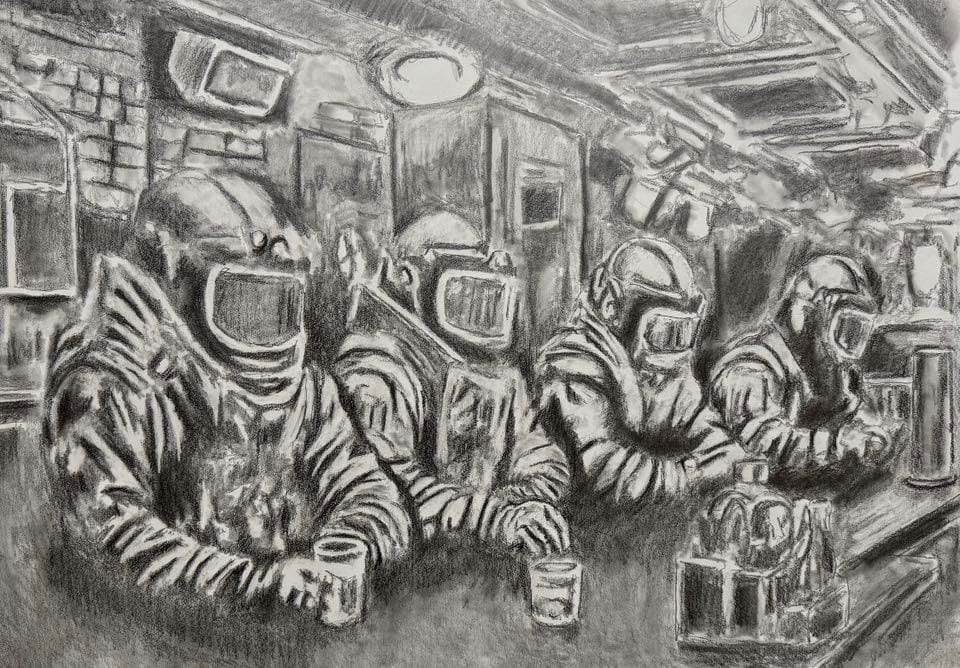
It’s not hard to see why. Colomer’s work is striking. He almost exclusively paints scenes based around his time as a bomb expert. Faceless people in technologically advanced suits are his main subjects. Despite the inherent inhumanity of a figure in a blank facemask, Colomer imbues them with incredible weight and empathy. Four bomb squad members might sit exhausted at a bar holding drinks, or another will flip off the camera in a fit of anger. There is something almost mythological about his paintings.
“I don’t want to represent one specific group,” said Colomer. “Each branch of the military has bomb squad, you know, across the United States at different police and fire departments, emergency response units, they have a bomb squad. I wanted to represent the entire community.”
However, he continued by explaining the facelessness helps remind people of the stakes inherent in the job.
“When you have that helmet on, it’s absolute sensory deprivation, which I’m trying to capture,” he said. “It’s like blinders on a horse. You’re very, very specific in your mission, and you’re clearly focused on one thing, and that’s the hazard that’s downrange, whatever it is. You have a security team that’s there, that has your back, which is a subtle mention artistically that there’s somebody there that’s protecting you while you’re doing this dangerous job.”
Once he got to painting, Colomer reached out to Artists and Arms, the Houston charity that helps veterans reconnect with society by promoting community art gatherings. One of the people Colomer met was Earl “Chan” Smith, a miniaturist who encouraged him to keep painting.
“He does art that is deep-seated in his emotions and experiences,” said Smith in an email interview. “His pieces help him heal through art.”
In 2025, Colomer started working with charcoal, making his pieces even more striking. He slowly picked up 10,000 followers on Facebook and Instagram under the name Little Dog Studios, with several time-lapse painting videos going viral.
His work has made him an unofficial artist-in-residence for the bomb squad community. Colomer has also been invited to contribute to a national monument. An etching of one of his bomb squad figures will be on a face of the monument, honoring the brave people who risked their lives as he did with an immortalization by someone who knows the life intimately
Painting seems to have brought a lot of peace to Colomer. Despite the seriousness of the bomb squads’ jobs in his art, he also inserts whimsy. In fact, he says that art is more like defusing a bomb than you might think, adding to his credentials for this particular creative niche.
“Ninety percent of what we did disarming bombs was made-up on the go,” he jokes. “You could train all day for a car bomb, but what does a car bomb look like in real life? Where is it in the trunk? Is it in the backseat? Is it under the hood? What are the fusing mechanisms? Well, that’s really similar in art, but with a blank piece of paper and a pencil. You’re literally creating something from scratch, in art or disarming bombs.”

Comments ()