UT Austin Handed Out Drink With ‘Opioid-like’ Ingredient As Poison Calls Climbed
Despite warnings, Feel Free gained mainstream traction across Texas—including on the campus of the University of Texas at Austin, where the drink was distributed at student events under official sponsorship.

“This is the viral gas station drink that landed me in rehab,” McKenzie Wisdom announced, pointing to a little blue bottle labelled Feel Free. Wisdom is a wellness influencer, a Bali-trained yoga instructor, and Founder and CEO of Wise & Well. Her small business curates “luxury wellness experiences to restore your body, mind, and spirit,” according to their website. Today, she is the picture of health.
Three years ago, that was not the case. She says she was heavily addicted to Feel Free, taking anywhere from 6 to 7 bottles a day. She was spending a large portion of her income on the drink, and described how her “life began to literally revolve around this substance, it was all I could think about.” Like many addicts, she describes how she could not get out of bed without her drug of choice, and chose to enter rehab after hitting a breaking point: “I was miserable while I was using, and I was miserable when I was going into acute withdrawals.”
Wisdom is one of many health-conscious young people who say they developed an addiction after encountering Feel Free through wellness marketing. In her case, a favorite podcast promoted the drink as a “social lubricant” and “alcohol alternative”—with no mention of its active ingredients: a mixture of kava and kratom. Kratom contains 7-hydroxymitragynine (7-OH), a compound the Texas Department of State Health Services recently classified as “opioid-like,” noting it can be up to 13 times more potent than morphine. Despite these warnings, Feel Free gained mainstream traction across Texas—including on the campus of the University of Texas at Austin, where the drink was distributed at student events under official sponsorship.
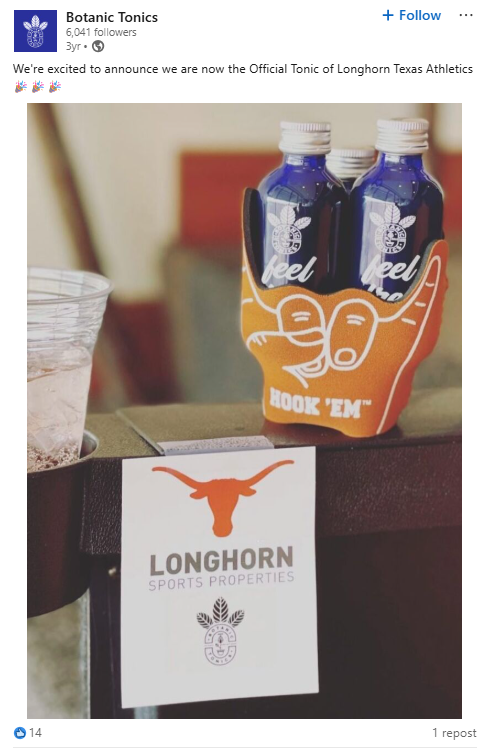
Botanic Tonics, the makers of Feel Free, began sponsoring Texas Athletics in January of 2022 via a deal brokered by Longhorn Sports Properties. On April 1st, 2023, a Feel Free booth was erected at the Longhorn Run, an annual tradition since 2010. Sana Haider, a student and runner that day, had the foresight to Google the active ingredients after taking a free sample that had been marketed as a “study aid.”
“I can’t believe a UT event serves this in a place where students and families are all present,” she wrote on a UT Austin subreddit. “This is basically as addictive as opiates. It should be illegal, but probably isn’t because it’s not well-known.” Some users pushed back, arguing that anything—including Kratom—can be safe in moderation. Others dismissed the warnings entirely, suggesting that the idea of a gas station drink acting like an opioid was simply an April Fool’s Day joke.
Years later, there is now growing concern that Feel Free is an addictive substance that has pushed many health-conscious young people into dependency, withdrawal, and even rehab. Yet, Texas Athletics maintained its partnership for more than two years—even after a class-action lawsuit was filed on March 28, 2023, just days before the Longhorn Run. The suit alleged that Botanic Tonics and 7-Eleven failed to warn consumers about the addictive nature of Feel Free. In 2024, the company agreed to a nearly $9 million settlement. UT made no public comment and continued the sponsorship until July 2025. (Neither Longhorn Sports Properties nor Texas Athletics responded to a request for comment. A representative from UT Austin’s Center for Students in Recovery confirmed familiarity with the sponsorship but declined to be interviewed for this story.)
A recent report from the Texas Poison Center Network states that reports of 7-OH exposures have nearly doubled in the past year, rising from 107 to 192. Yet, Texas’s efforts to regulate the overall sale and distribution of kratom and other 7-OH products have been feeble at best. State lawmakers did pass a Kratom Consumer Health and Safety Protection Act in 2023 (Senate Bill 497), which forbids the sale of “concentrated” 7-OH products. However, enforcement of the law is almost entirely lacking—DSHS wrote that “products containing concentrated 7-OH are sold as pills, gummies, candies, and imitation ice cream cones at gas stations, smoke shops, and online.”
A 2025 bill (Senate Bill 1868) proposed to classify kratom as a controlled substance and impose harsher restrictions, such as a blanket ban on Kratom in all pill or smokable forms. SB1868 would also have limited the sale of products like Feel Free near schools. However, the bill stalled in the House and was never passed into law. The lack of meaningful oversight has enabled companies like Botanic Tonics to defend their controversial products.
In a written statement to The Texas Signal, a representative for Botanic Tonics said, “Our product contains natural kratom leaf and is not targeted by the FDA… As our Feel Free Classic product is compliant with the law, distribution is unaffected.” The company added that it provides “transparent information” to retailers and consumers. Still, a discreet serving size note—limiting use to one bottle per day—has done little to deter retailers from stocking or selling the product in bulk.
Feel Free isn’t being marketed on the dark web or in back alleys—it’s promoted on wellness podcasts, handed out at university 5Ks, and shelved alongside Five-Hour Energy in gas stations. Botanic Tonics may avoid chemical concentration, but that still leaves many consumers who say that Feel Free turned into a potent—and addictive—compound in practice, regardless of what's on the label.
What remains unanswered is how a university with a top-tier medical system and a dedicated addiction-recovery center allowed a product containing an ingredient the State of Texas now labels as ‘opioid-like’ to be promoted under its name for years. That gap between regulation and enforcement leaves students—many of whom are young, health-conscious, and inclined to trust university-affiliated brands—especially vulnerable. Poison calls are rising, rehab admissions are increasing, and the companies responsible insist their products are safe. UT’s quiet withdrawal from the sponsorship doesn’t resolve the lingering question: when the next “wellness drink” appears, who will be watching out for the students?



Comments ()