Who Enforces The Ten Commandments In Texas Schools
In some Texas classrooms, the Ten Commandments are already up, part of the visual landscape students see every day. In others, identical posters sit unopened in storage rooms, waiting for guidance that hasn’t come.

When Texas ordered every public school classroom to display the Ten Commandments, it left out one critical detail: how the posters would get there. Now, despite legal tensions and questions about the separation of church and state, private citizens are being deputized to carry out a mandate that may violate the Establishment Clause of the First Amendment.
The Legal Landscape
When Senate Bill 10 was enacted on Sept. 1, 2025, it required all primary and secondary public schools in Texas to display a Protestant version of the Ten Commandments in every classroom. The bill faced nearly immediate public backlash as teachers, students, parents, administrators, and community members—of all faiths, Christians included—condemned the state-sponsored endorsement of one set of religious beliefs in American classrooms.
“Texas classrooms belong to all of us – to children of every faith, and of none,” wrote Calvin Warner, Board Member of the advocacy organization Texas Freedom Network (TFN), on Feb. 20, 2026. “But when Governor Greg Abbott signed Senate Bill 10 into law in 2025, he handed the government a power it was never meant to have: the power to tell Texas children what kind of faith is acceptable.”
Warner explains that TPN is one of many pro-freedom-of-religion organizations that have filed an amicus brief in Rabbi Nathan v. Alamo Heights Independent School District, one of the first lawsuits to emerge in response to SB 10. “A coalition of Texas families representing diverse religious backgrounds – including rabbis, a cantor, a reverend, and parents of many faiths – sued to block the law. A federal district court granted a preliminary injunction,” wrote Warner.
However, U.S. District Judge Fred Biery’s preliminary injunction only applied to the 11 defendant districts named in the litigation. Americans United for the Separation of Church and State (AU), a key a national advocacy group that has taken a lead role in litigating Texas church–state cases, explained in a press release that: “Despite the court’s ruling that the displays would be “plainly unconstitutional,” some Texas school districts that weren’t defendants in the Nathan case began to display or announced their intention to begin displaying Ten Commandments posters.”
AU filed a second case, Cribbs Ringer v. Comal Independent School District, on behalf of a new group of 15 multi-faith and nonreligious Texas families who attend 14 of these districts. In the complaint, AU states that “The Establishment Clause of the First Amendment to the United States Constitution guarantees that “Congress shall make no law respecting an establishment of religion,” and that “by mandating that a state-sanctioned version of the Ten Commandments be displayed in every public elementary and secondary school classroom in Texas, S.B. 10 impermissibly prefers a set of distinct religious beliefs and dictates and will impose those preferred religious beliefs and dictates on Texas’s public-school children.”
In response, U.S. District Judge Orlando L. Garcia issued another preliminary injunction requiring those districts to remove the displays by Dec. 1, 2025, and prohibiting them from posting new displays.
Yet the pattern continued to emerge: while districts named in litigation were forced to halt or reverse implementation, those outside the scope of court orders were required to proceed.
Private Enforcement of a Public Mandate
Despite the mandate, SB 10 did not outline a clear mechanism for how independent school districts would fund or distribute the posters.
As of this writing, only one school district—Frisco ISD—has been found to have purchased the SB 10-compliant posters with taxpayer funds. Nichole Manning, a plaintiff in Cribbs Ringer v. Comal, is a Frisco ISD parent of one elementary school student and one high school student who joined the lawsuit on behalf of her children. According to the complaint, an email received by all parents stated: “The Ten Commandments will be on Frisco ISD classroom walls by the start of school,” and further stated that the Ten Commandments “is the only religious text that will be permitted to be displayed in Frisco ISD classrooms.” The complaint estimates that the district spent approximately $1,800 to fund the religious displays.
The law does not require that districts spend their own money to procure the posters. However, it does require districts to accept donations of posters made by private citizens. In lieu of a formal distribution system, faith-based advocacy organizations like Restore American Schools have stepped in to empower private citizens to fund, produce, and effectively enforce the mandate themselves—regardless of the ongoing legal battles.
The homepage of Restore American Schools announces that, for $30, any private citizen can “adopt” a school to “stand for truth in [their] community.” As of March 22, 2026, Restore American Schools has facilitated the “adoption” of 4,311 Texas schools, effectively impacting over 3.5 million students in the public education system. However, it is not as simple as providing a donation and letting the organization handle delivery. Through a series of Frequently Asked Questions, Restore American Schools provides a guide to private enforcement:
“May I mail the poster bundle instead of delivering it by hand?”
“No, you must deliver your bundle to the District Administration Office directly. If you are in Texas, you will likely be asked to fill out an “in-kind” donation form.”
“Do I need permission from the school district before delivering the posters?”
“You do not need permission from the school Administration Office, but you are welcome to call for the hours the office is open prior to delivery.”
“What if a school refuses to accept the posters?”
“Remind them that the posters are to abide by the new state law. Provide them with a copy of the law that was provided in your package.”
“What if staff question the legality of the posters?”
“You will receive a copy of the law in the bundle you were sent. Please provide that to them and ask that it be given to the superintendent. You do not need to engage further.”
The campaign does more than provide posters; it trains private citizens to enforce compliance, making them intermediaries between state requirements and classrooms. This creates a system in which implementation is no longer at the district’s discretion but at its constituents'—specifically, those willing to intervene in the name of “standing for truth.” While courts continue to debate whether SB 10 is lawful, the posters—funded, delivered, and installed through this decentralized process—are already changing classrooms throughout Texas.
Restore American Schools makes no mention of the ongoing litigation, instead citing “a unique legal opportunity now…to restore and defend our history and traditions.” Yet, rather than a legal argument, they rely on the Ten Commandments’ presence as a “cornerstone of American education…in the New England Primer, America’s first widely used schoolbook for over 150 years,” as evidence for its continued presence in classrooms.
On page 6 of the New England Primer, there is a section labelled “The Dangers of Individualism and Need for Conformity.” On page 7, it goes on to detail the function of the Primer: “With it millions were taught to read, that they might read the Bible… [to avoid] children taken in their earliest years, drilled and taught to believe that they were to think for themselves.”
ACLU Program on Freedom of Religion and Belief director Daniel Mach addressed the unilateral nature of SB 10 in a recent press release: “Politicians in Texas should know by now that public schools aren’t Sunday schools. Religious liberty belongs to all public school students and families, not just those who embrace some government officials’ preferred scripture.”
Restore American Schools did not respond to a request for comment. Their final FAQ answer involves the press: “If someone from the media approaches you in person, via phone or email we suggest you tell them you have no comment.”
“The Hays Way”
When the posters began arriving in classrooms, there was noticeable pushback in both classrooms and courtrooms. Educators took to social media in droves to discuss SB 10 and its implications for their students. Some favored the law, but the majority—including Christian educators—wondered how the Ten Commandments’ presence in classrooms would impact students of other faiths, or no faith at all.
Heather Shahan, teacher at Griffin Elementary School in Forney ISD, posted on Threads about an interaction with a student: “One of my girls who is currently fasting for Ramadan asked me why I bought it. "I didn't," I told her…Our [teachers’] beliefs do not matter. What matters is that we welcome and accept all of our students. We agreed that, by posting one doctrine, we are proclaiming it as the "right" one by default.”
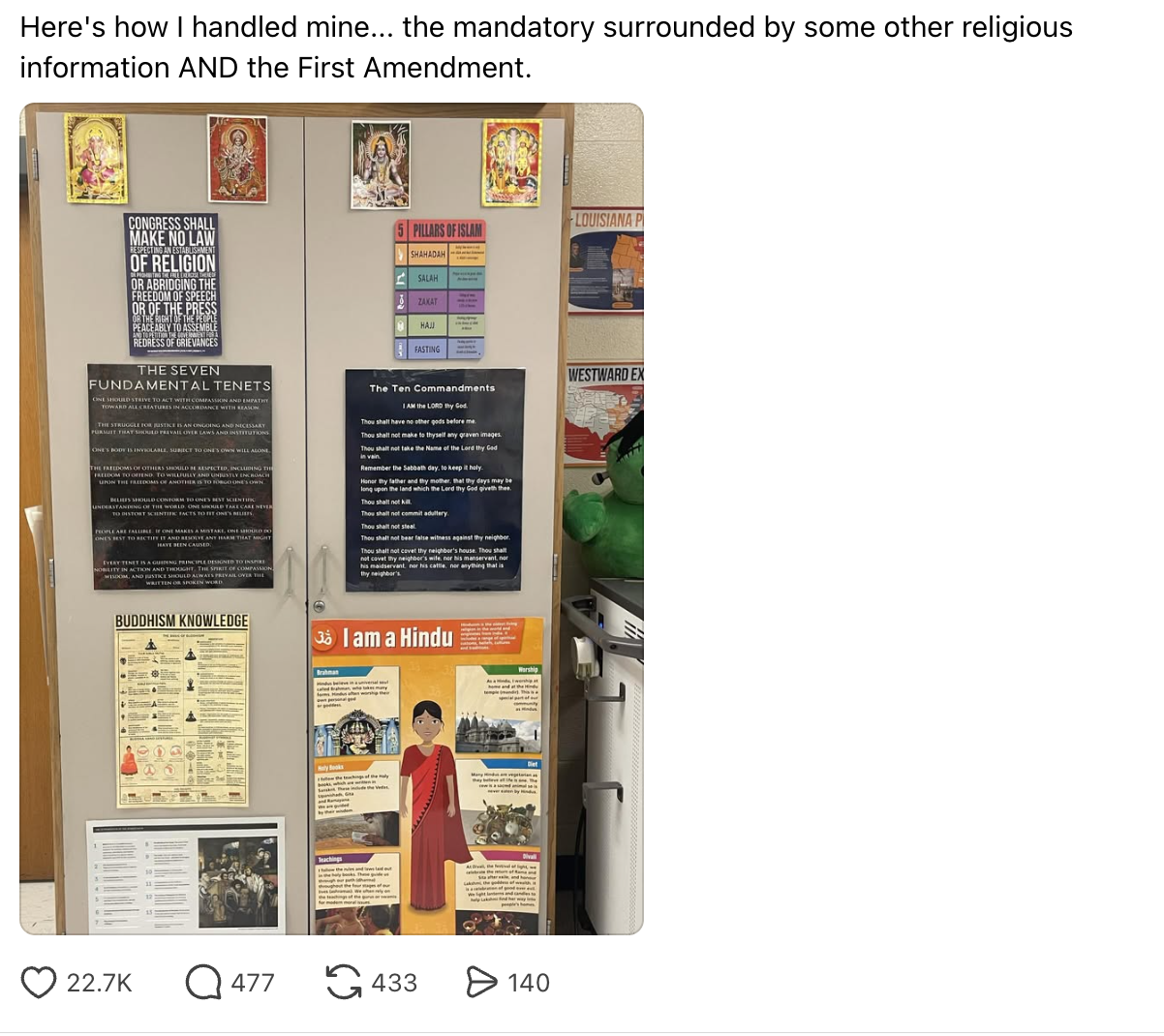
Shahan is not alone—thousands of teachers have expressed similar views and discussed plans for creative compliance. One educator, who wished to remain anonymous, shared that she has decided to surround the Ten Commandments poster with the Five Pillars of Islam, the Four Noble Truths of Buddhism, a poster explaining aspects of Hinduism, and a copy of the Establishment Clause. Other teachers have made similar displays, and some parents have sent their children to school in First Amendment buttons.
Hays CISD has taken a similar district-wide initiative. On September 15, 2025, Superintendent Dr. Eric Wright sent a letter to all families with children enrolled in the district, informing them of the passage of SB 10. Additionally, he states that Hays CISD is “in receipt of donated posters for its 2,550 classrooms” and that there is no injunction against its school district.
“One of the arguments of the state for displaying the Ten Commandments in schools is that they are foundational, historical concepts that have shaped many of the laws of the United States,” wrote Dr. Wright. “That description fits the first ten amendments to the United States Constitution–the Bill of Rights, which also happens to be the primary argument against posting the Ten Commandments in classrooms. The Bill of Rights contains the First Amendment that begins with, "Congress shall make no law respecting an establishment of religion...." While Senate Bill 10 prohibits any other content besides the Ten Commandments on the Ten Commandments posters, there is no restriction that would prevent Hays CISD from displaying the Bill of Rights next to or near the Ten Commandments posters. The district intends to do this to give students a broader understanding of not only the responsibilities by which they might choose to live, but also the important individual freedoms they enjoy as Americans or while on American soil.”
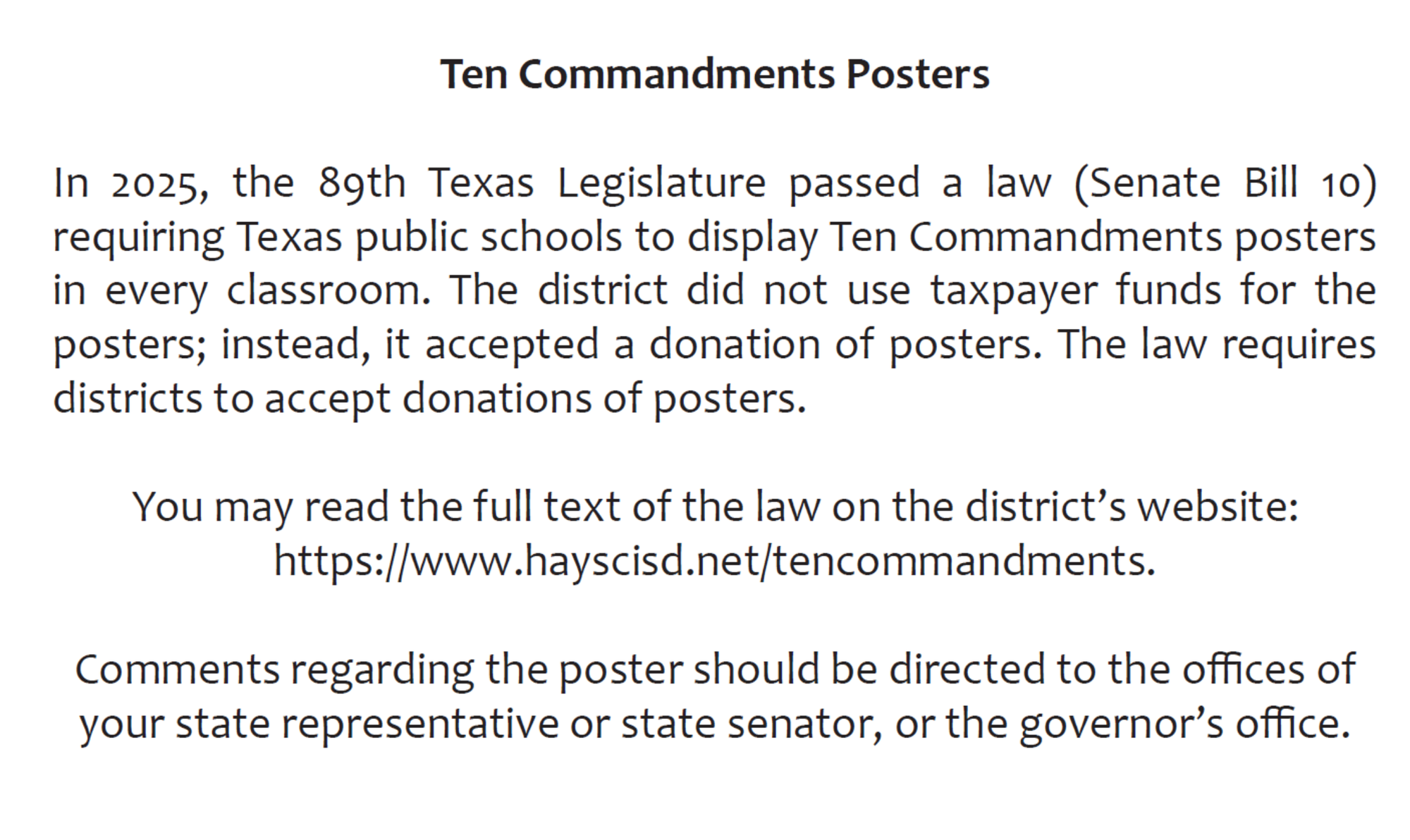
Dr. Wright calls this dichotomous display “The Hays Way.” Though the district did not purchase its own Ten Commandments posters, it funded the Bill of Rights posters. In each classroom, between the two displays, hangs this notice:
In some Texas classrooms, the posters are already up—mounted beside whiteboards and lesson plans, part of the visual landscape students see every day. In others, identical posters sit unopened in storage rooms, waiting for guidance that hasn’t come. In a handful of districts, they’ve been taken down entirely, caught in the crosshairs of a legal fight that is still unfolding.
SB 10’s ultimate enforcement may not be decided by the legislature alone, or even by the courts, but by the system that has formed around it. By leaving implementation undefined, the state created a space for private actors to step in—funding, delivering, and enforcing compliance in real time. As the legal battle continues, the question is no longer only whether the law is constitutional, but whether a mandate carried out through private hands can be meaningfully restrained once it has already reached the classroom.


Comments ()