
A Texas Literary Horror Collection Rooted In Reality
Many of the stories in the collection from Texas women are designed to be pure nightmare fuel running on the gasoline of lost bodily autonomy

Lauren Oertel’s story, “Routine Surgery,” has an ending she believes many women across Texas are experiencing in nightmares. A young Texas woman, Hannah, watches as the state legislature gleefully starts stripping away reproductive choice, including birth control, extolling the value of motherhood. Desperate to prevent herself from an unwanted pregnancy, she schedules a tubal ligation. On the day she goes in for the procedure, just as the anesthesia pulls her under, she notices her regular woman doctor has been replaced with an older man.
Beneath the Bluebonnets (available now from Castle Bridge Media) isn’t only about the post-Dobbs medical landscape of Texas, but the vast majority of the stories in the collection from Texas women are designed to be pure nightmare fuel running on the gasoline of lost bodily autonomy. The collection is a visceral reaction to ideas that have dominated mainstream state politics for more than a decade.
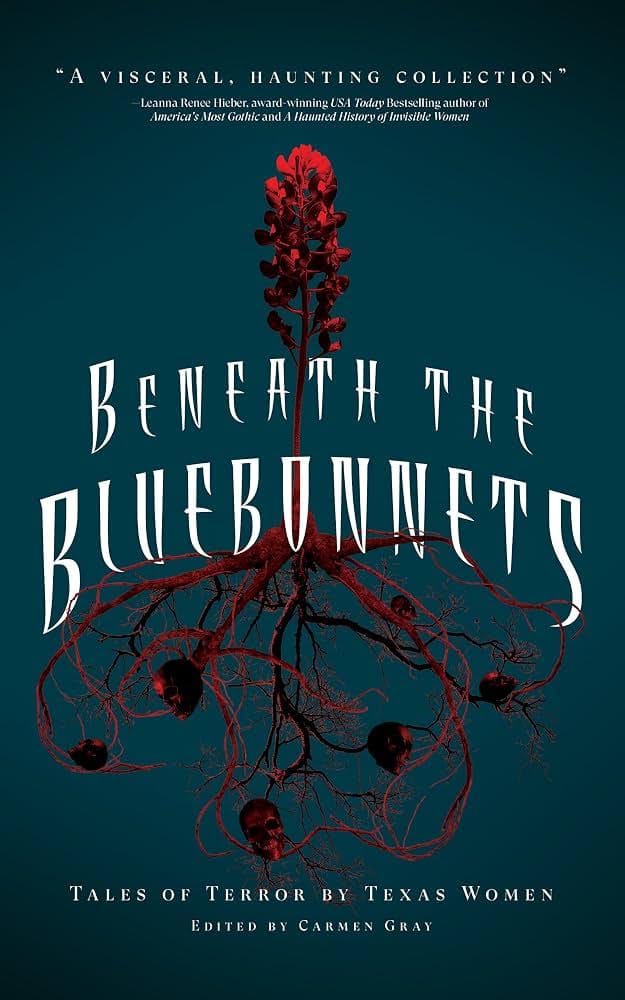
Editor Carmen Gray began working on the anthology a decade ago after noticing that she was the only woman in the latest volume of the long-running Texas horror series Road Kills. Again and again, she would find herself alone in a room full of men, few of which seemed to understand the core of the horror women were writing about. She decided to take matters into her own hands.
“I wanted to make it all female and all my own,” she said in a phone interview. “I like the idea of Texas because I am a native Texan. I'm Tejana. My mom's family goes back several generations to Goliad. I really want this to be Texas women because of the whole political environment of Texas and what was happening. This is a horror that women deal with more than anybody.
Gray’s own story is a dark counterpart to Oertel’s. “The Disappearing Women” might as well take place a little further along in the “Routine Surgery” timeline. This time, a woman newscaster tasked with mollifying the population as women are systematically either married off away from careers or disappeared, struggles with the older man who has staked his claim on her. It’s an inside view of the cage that patriarchy is finishing, where even the women who are allowed a longer leash are living on borrowed time.
The horror of Beneath the Bluebonnets is not gentle, even when it borrows from classic gothic tropes. “Bettina” by R.J. Joseph opens the collection with an antebellum slavery story that turns into a gruesome revenge that would put The Perfection (2018) to shame. Even Joseph’s gore-filled tale is overshadowed by “This I Know” by Iphigenia Strangeworth. In that one, a deeply religious man goes off-grid with his family where he can rule as a backwoods god-king and practice serial killing in the name of the Lord.
And yet, it’s never puerile. Strangeworth tells her story through the points of view of two sisters, an angry deaf girl blinded by her father for insolence and her developmentally delayed twin sister who struggles with troubling feelings of empathy for her father’s victims. The core of the atrocity is how one man’s fundamentalism and authority warps the women around him.
There’s a point to it. Horror often cuts through the fog of politics. There’s a reason we’re living in a golden age of enlightened horror films from people like Jordan Peele, Jane Schoenbrun, and Robert Eggers. By making people feel this terror, authors like Oertel hope to reach people growing numb to Texas politics. Barring that, she hopes maybe she can remind people the nightmare is real.
“I want people to feel less alone in living in the horrors of our reality,” she said in a phone interview. “That can mean not feeling gaslit when we are worried about how bad things already are and how much worse we can see them getting. I encourage people to read horror stories written by people who are mostly likely to live those horrors. Our fears are based in real experiences, and we don't have to feel like there's something wrong with us for expressing them.”
All Beneath the Bluebonnets does is give the reality a few blood splatters and jump scares. Part activism, part talk therapy, the book is a canary in the coal mines for the way women feel in Texas right now.
“One of everybody’s greatest fear is not having really not having control of themselves. That's kind of universal,” said Gray. “Certain people in the population have to fear that more than others, and definitely it's women, and then even more definitely, it's going to be, women of color. When women have a platform to write about their fears, it’s almost in a way it's therapeutic.”

Comments ()