
A Texas YouTuber Takes On The Consumerist Christian Right
Taylor Leigh is a deconstructed Christian and a child of missionaries turned vocal critic of her former faith.

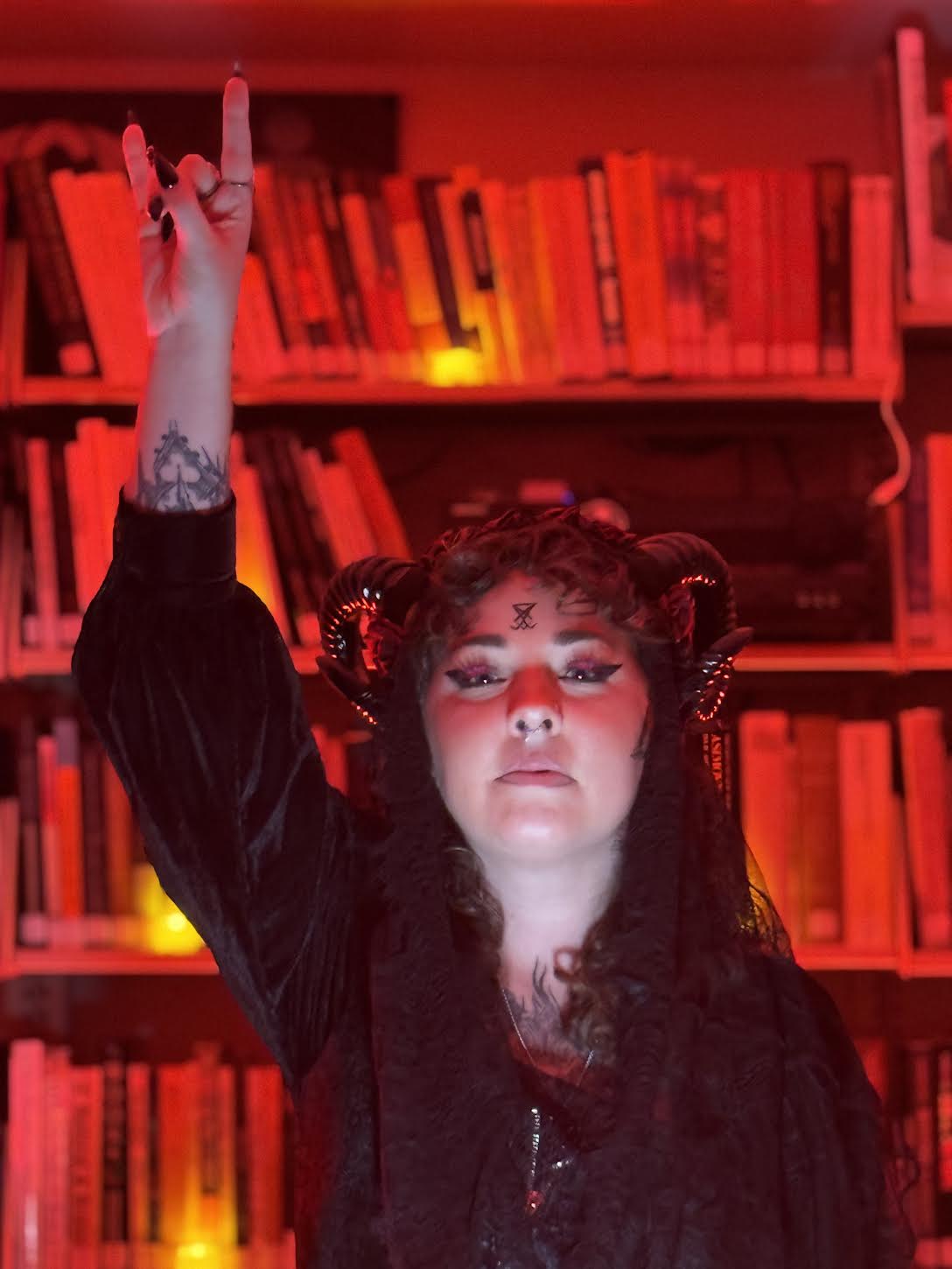
YouTuber Taylor Leigh looks and sounds like a classic Disney villain, and to the Christian far-right, she might as well be. Known as the Antibot, she is a deconstructed Christian and a child of missionaries turned vocal critic of her former faith. Her primary target in her videos is the bizarre intersection between populist Protestant Christianity and hyper-consumerism.
“This commodification of Christianity is exacerbated in this era of social media because just the regular Christian can build himself up a following on social media, talking about Jesus, talking about the church, and then use that following to make money,” she said in a phone interview. “We see a lot of Christian influencers who quickly come out with products. They market their products or whatever they're offering to their followers in their niche by claiming that it's Christian. They'll just kind of slap Jesus on like it's branding and there's not really any substance to it.”
Born in Ohio, Leigh moved with her missionary parents to Indonesia when she was just 10 years old. After she graduated high school, she moved to Austin in 2015 to attend a Christian aviation college. There, she met her husband, Drew McCoy, a successful YouTuber in his own right under the moniker Genetically Modified Skeptic. McCoy was already beginning his deconstruction from Christianity, though Leigh says he never pressured her to do the same.
Instead, Leigh’s introduction to the world of conservative Christian criticism started from the multi-level marketing (MLM) industry. She had family that were involved in Young Living Essential Oils, a company repeatedly rebuked by the Food and Drug Administration (FDA) for unfounded claims that the oils could cure everything from urinary tract infections to Ebola. The company has been called a pyramid scheme in at least one lawsuit, saying 94 percent of sellers make only $1 a month.
One way that Young Living and many other American MLMs recruit is to frame the business structure as deeply connected to Christianity. A former employee of Young Living told Business Insider that the products were part of a sacred mission from God to heal the world. This type of branding that blurred the line between faith and huckster capitalism was the first step on Leigh’s road toward prominent commenter.
“A lot of the arguments that MLMers give for why you should join their company are very, very similar to the arguments that you'll hear among evangelicals for why you should become a Christian,” said Leigh. “So I started questioning some things and ended up leaving the church.”
Christian commodification has become a large niche business. Influencers sell classic products like videos, books, and seminars, but it extends to things like athleisurewear and the aforementioned energy drink. Leigh gives an insider’s view of the increasingly twisted relationship between affirming Christ and conspicuous consumption.
Take her exploration of the intersection of evangelical influencers and Disney. Influencers take Disney cruises as a way to have a nice vacation full of recognizable imagery while also getting to video prayers on Castaway Cay, a kind of colonization of one of America’s most beloved IPs. Another travel planner offers Bibbidi-Bobbidi-Bible studies. Many influencers claim their trips are ministries even when it’s little more than praising God in a hashtag while wearing Mickey Mouse ears.
It seems silly and harmless, but hyperfocusing on expensive Disney vacations while extolling conservative Christianity has a lot of subtle implications about the state of wealth in America.
“They're not taking some sort of meaning from their movies that they think applies to their life,” said Leigh, “They're tying Christianity and their faith directly to the brand. Living out their faith means going to Disneyland, which seems like a very corporatized way of doing religion that leaves a bad taste in my mouth.”
Leigh’s work highlights how shallow expressions of faith through consumerism often are thanks to online influencers. Jesus is used as a tendon to tie together the muscles of hard right-conservatism, white male supremacy as “traditional values,” and making money. Actual discussion of the deeper meaning of scriptures rarer than ostentatious proofs identifying with the Christianity brand brings material wealth.
What started out as criticism of MLMs ended up addressing a deeper sickness in America: the social media push to use religion to make conservative politics and the excesses of capitalism easier to swallow. There is one upside, though. Prolific and popular as these influencers often are, Leigh believes it's a façade as obvious as Cinderella’s castle.
“I think that the religious right likes to act like there is some big religious revival happening among Gen. Z, but when you actually look at the data on that, it's not really happening,” said Leigh. “It is something to be concerned about for sure because pipelines on social media are very real. People, especially younger white men, can be sucked down these kind of far-right pipelines, but I think to a certain extent, some of that is astroturfed and just the religious right pretending that they have more people interested in their stuff than there really are.”

Comments ()