Cressandra Thibodeaux’s Life Of Activism Endures Beyond 14 Pews
Cressandra Thibodeaux will be showcasing her photos of the United Houma Nation, perhaps "America's first climate change refugees," in an exhibition at the Wetlands Museum this summer
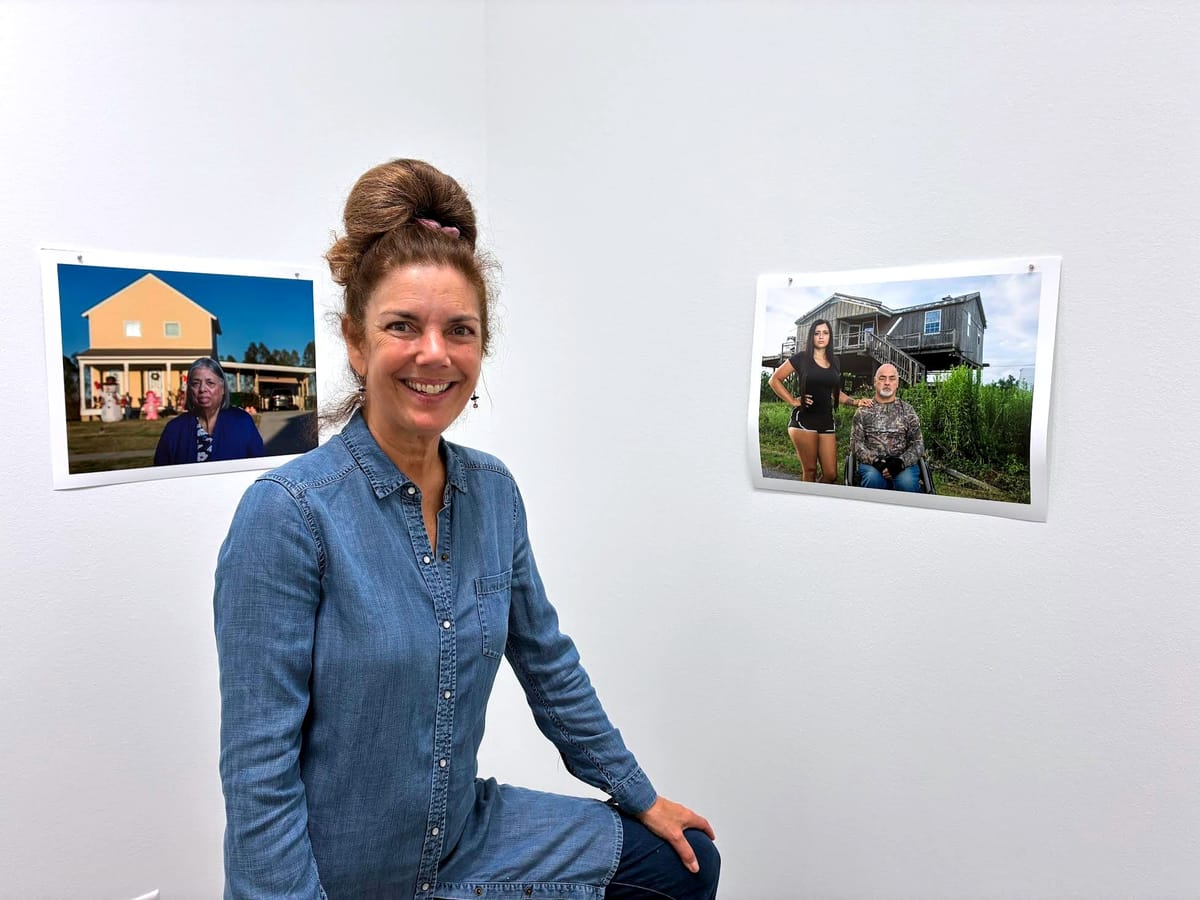
For more than a decade, Cressandra Thibodeaux was the host, curator, and presenter at Houston’s 14 Pews microcinema, a home for strange films, art happenings, and workshops. Now, she’s an artist, but her love of spreading under-told stories has not changed.
In person, Thibodeaux is something of a human film projector herself. The door hadn’t even fully closed at her new studio at the Silos at Sawyer Yards before she began rattling off the details of her latest project, her speech rapid and clipped like a film reel as she launched into the impassioned story.
Her studio doesn’t yet have that lived-in feeling that most spaces in the Silos eventually acquire, but the plain white walls are adorned with her portraits of Native Americans. Her subjects are not smiling, vaguely resembling American Gothic. Half of them stand in front of dilapidated homes familiar to anyone who has lived in a fishing neighborhood along the Gulf Coast, and the other have are modern houses that are so painfully bland they look like they were designed by an indifferent AI. The lined faces of the people in front of them stand out as unbearably real.
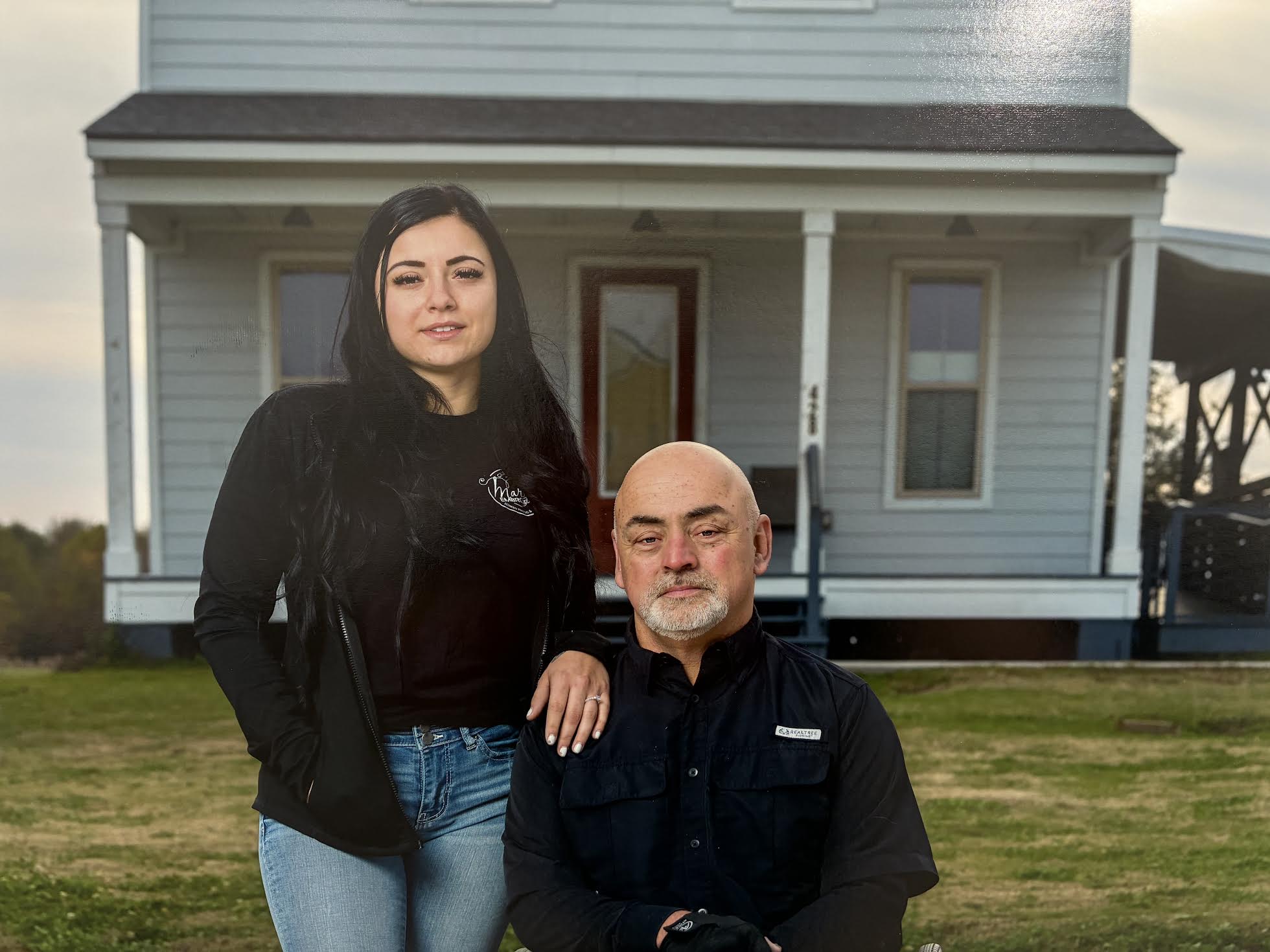
These are members of United Houma Nation, a state-recognized tribe in southeastern Louisiana that might be the rightful owners of the Port of New Orleans if they were federally recognized. Thibodeaux refers to them as “America’s first climate change refugees” thanks to their eroding land being overdeveloped and polluted by oil and gas companies as well as shipping interests. Thibodeaux will be showcasing her photos in an exhibition at the Wetlands Museum this summer.
The tribe accepted a $48 million grant in 2016 from the U.S. Department of Housing and Urban Development to relocate, though the tribal members Thibodeaux interviewed say that the State of Louisiana has not been handling the money well. Members of the tribal community have reportedly been seeing homes around them sold to white owners and investors, diluting what was once a tight-knit population. That’s where the soulless-looking homes in the second set of photos come from.
“I was just there a couple months ago where I was photographing now the new houses with the for-sale signs built on the land that was supposed to be all theirs,” she says. “But nope, it's houses that they're selling to outside individuals that are pretty much white. A woman came out, very bless-your-heart, what are you doing? Turns out it's a religious realtor company. and they have gotten the access to sell the homes, and they get a cut of the homes, this religious group. I was like, Jesus has a realtor?”
Thibodeaux, who is Native American (Sault Tribe of Chippewa) herself, has never been one to stay out of a fight. In 2021, 14 Pews was showing Benedetta, director Paul Verhoeven’s story of a lesbian love affair between Catholic nuns, when a mass of protestors showed up. Undeterred, Thibodeaux scheduled another screening for Christmas Day.
The phrase “down for anything” adequately describes Thibodeaux, whose tenure at 14 Pews included everything from cat video festivals to controversial documentaries. During the interview, she launched into another wild story, this one about one of the first events after she bought the microcinema.
Artist Emily Sloan, who would become the first 14 Pews artist-in-residence, hosted her famous Funeral for the Living where people wrote obituaries for her. The event turned into a bonfire where people burned a black casket in the backyard while people sang, recited poetry, or played music.
“Some woman, 20 years old, took off her bra screaming she was a virgin and wanted to get rid of her virginity,” says Thibodeaux. “People cheered. Someone pulls out a crack pipe, throws it in the fire, and it explodes. Oh my god, it was awesome. The next day we had to sweep up crack pipe glass so my dogs wouldn’t cut their feet.”
That was the typical energy of Thibodeaux until 2024. Her mother, who had served as the venue’s bartender, started to have severe neurological struggles, and Thibodeaux couldn’t imagine running the “church of cinema” without her. She sold the venue to Sloan, who hosts artist events there still, but it is no longer what it was.
Instead, Thibodeaux has embarked on activism and photography, and her work with the Houma is a good start. Still, that old punk rock attitude has not left her. She is even returning to 14 Pews on March 28 to give a talk on how she pressured a German museum into returning a set of Native American scalps in their collection.
Stories of the American Old West are huge in the Rhineland. Adolf Hitler was obsessed by tales of cowboys fighting tribes and partially based his Holocaust plans on the treatment of Native Americans by the United States government. There was an author named Karl May who made a huge name for himself writing a series of novels about a Native American hero named Winnetou. These were essentially the Marvel films of 19th Century Germany, and May’s work is beloved to this day.
His museum in Radebeul had the scalps; Thibodeaux wanted to get them back. At first she planned a heist, but was dissuaded by tribal leaders. After initial negotiations went nowhere, Thibodeaux told the museum she was going to use a Fulbright scholarship to study whether any Jewish Germans had ever played Native Americans in the museum’s regular powwow performances or stagings of the Winnetou musical.
“Two months later they gave back our scalps,” says Thibodeaux. “I don't know if there was a correlation, but I did say I would be there every day researching whether German Jews were playing Apache warriors at their museum.”
Any other person in Houston telling that story would sound like they were telling tall tales. When Cressandra Thibodeaux does? It’s just Thursday. She may not have her cinema anymore, but she is still showing stories that would otherwise fall through the cracks.

Comments ()