Exploring Feminism In Galveston’s Red Light District
Kimber Fountain was vaguely familiar with the broad strokes of Galveston’s history, but she’d never heard of The Line — a red light district headquartered on Postoffice Street — until she took a ghost tour

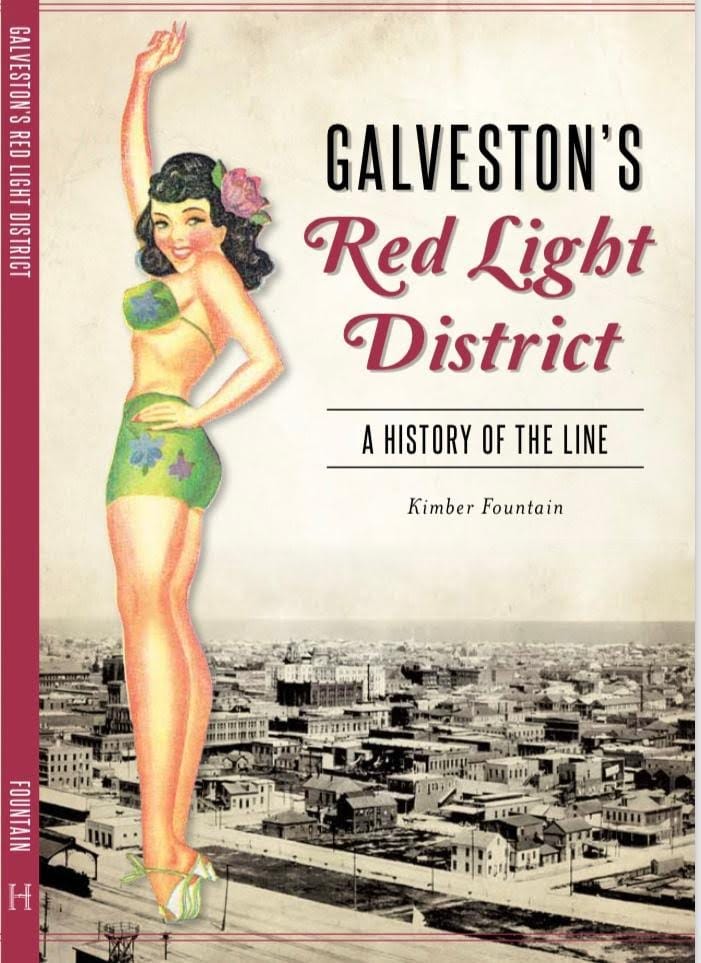
Few subjects are as contentious in feminism as the role of women sex workers, but Texas author Kimber Fountain masterfully dissects the subject in her book Galveston's Red Light District: A History of the Line.
It started with a ghost tour. That’s not as weird as it sounds. Galveston has had a strange relationship with history for decades. It is simultaneously an old city (pirate and slave trader Jean Lafitte started a colony there in 1817) and an oddly new one (being almost totally destroyed by a hurricane in 1900 and undergoing a radical shift following the fall of the Free State era in 1957). At any given point, the island’s history is being lost, rediscovered, sanitized, uncensored, celebrated, or forgotten.
Born in Bay City, Fountain was vaguely familiar with the broad strokes of Galveston’s history, but she’d never heard of The Line—a red light district headquartered on Postoffice Street—until she took one of the ghost tours led by the late Kenneth Alan “Dash” Beardsley. These days, Galveston is awash in ghost tours, but in 2012, Beardsley was one of the few voices talking about The Line’s history to popular audiences.
“Dash was the only person who had even a sliver of information available to the public out of all of the museums, all of the historical tours, everything that was available in Galveston,” said Fountain in a phone interview.
Bolstered by her love of mobster culture, Fountain delved into the history of the Free State of Galveston. From 1920 until 1957, Galveston’s economy and culture was dominated by crime boss brothers Sam and Rosario Maceo. They ran the town’s vice businesses; a sort of hedonistic colony divorced from the rest of a moralistic Texas. It was the age of the Balinese Room, moonshine runners up and down the coast, and celebrity resort culture before gambling relocated to Las Vegas. Naturally, the brothels and sex workers of The Line played a major part in that.
By her own admission, Fountain grew up fairly conservative and Christian, but as she delved into the lives of the women of the Line, she started to appreciate the need for feminism and how those women embodied freedom in an era after suffrage but before liberation.
“This book really opened my eyes to why feminism was important, why it's not just a political buzzword, why it is an actual movement that is important to the fabric of our society,” said Fountain.
What Fountain uncovers in in her books was how much the women of The Line defied expectations. While there were certainly women who turned to sex work out of desperate need, the majority of records Fountian could find showed that workers saw the industry as a path to freedom at a time when women had few options besides marriage and drudgery. It was their ambition that was starved, not their bellies.
“These women had complete autonomy and freedom, because it's no secret that financial freedom is real freedom, right?” said Fountain. “These women wanted to be pilots. They wanted to be engineers. They wanted to travel the world. They wanted to get master's degrees, and sex work was literally the only avenue that they had to achieve these lofty aims.”
It wasn’t all rosy, of course, and Fountain never shies away from the dangers of The Line in her book. Raids did occur. Men were almost never arrested or implicated in police round-ups, but the women were. A steep fine and their names printed in the paper awaited any sex worker who was caught in a police sting.
Pimps were abundant, violent, and sometimes murderous. Veneral disease was rampant, and being an illegal trade there were few official protections. Fountain’s portrait of Postoffice Street is not a utopia of women free from bonds by their sexually any more than it fits the “fallen woman” narrative espoused by reformers. It’s a more complex and real picture that is desperately needed.
“They didn't know they were going to be poster children for feminism in 50 years,” said Fountain. “They weren't trying to make some kind of statement. They weren't trying to tear down the moral fabric of society. They were simply going for the only avenue that they had available to them to assume their birthrights of freedom.”
Eventually, the days of The Line came to an end. Galveston may be an island, but the reformers of Texas made their way there eventually. The Maceos pulled up stakes and went to Las Vegas, disappearing into that new, glitzy den of sin in the desert. Galveston started a long, stumbling road toward being family-friendly, leaving much of its more sordid history to rot.
On Postoffice Street, the shells of the old Victorian brothels remain, but more reputable homes and businesses operate where once women stood in the windows selling sex to medical students, soldiers, bootleggers, and visiting businessman. Women have more options than they did, but still not equality. It was important to Fountain to capture this portion of feminist history accurately, not the least because of the context it lends the modern readers of her book.
“Today, sex work is largely illegal because most consider it immoral,” she said. “Yet, it has been extensively proven that the legalization or even decriminalization of sex work greatly reduces violence and sexual crimes against women and sex workers. So in the book I was basically asking the question, what if it’s not sex work that is wrong, but our morals? Because what could be more moral than changing the system in a way that would protect more people?”

Comments ()