
The Author With A Fix To The Immigration Crisis
Almost a decade ago, Houston author Loren C. Steffy laid out a clear case for why draconian anti-immigration policy was economically destructive. His new book builds on that case and offers solutions.

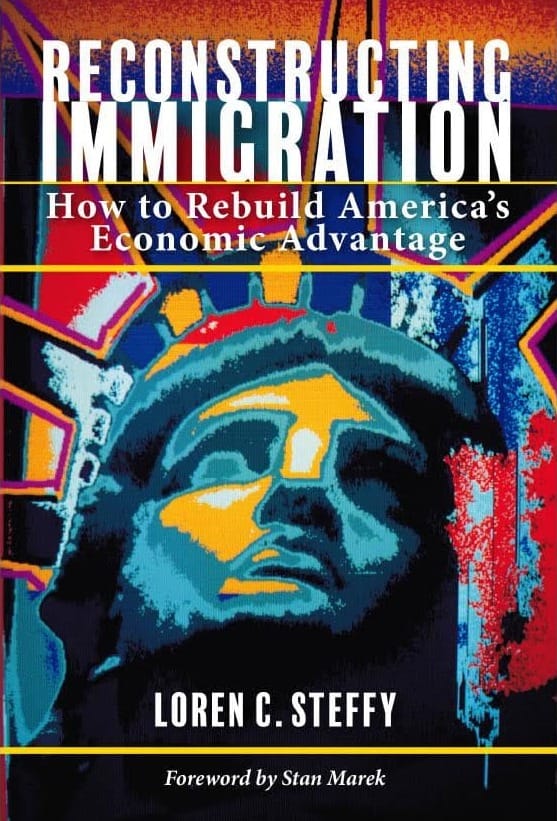
On Friday, September 18, I interviewed Houston author and columnist Loren C Steffy about his new book, Reconstructing Immigration: How to Rebuild America's Economic Advantage. Two days later, ICE agents shot Wilber Rafael Garces Perez, a 28-year-old Venezuelan man living in Austin, as he was working as a DoorDash delivery driver. The shooting mirrored that of Houston resident and Mexican national Lorenzo Salgado Araujo, who ICE agents shot in July as he was on his way to work.
Debates over immigration often turn on moral or emotional arguments. Steffy takes an economic approach, focusing on one simple fact in both these shootings: the men were working. Someone didn’t get their dinner and a construction project was delayed, a measurable economic loss of productivity.
In his new book, Steffy argues that the economic effects of removing workers are often underestimated, and that native-born workers do not necessarily fill the gaps left behind.
“When those workers are removed, all it does is slow everything down,” said Steffy in a phone interview. “The [man] who was shot by ICE in Houston back in July, that took an entire crew out of the mix because he was killed, and his crew was all detained. Those guys were building about a house a week. That's one fewer house every week that builder isn’t able to complete at a time when we have a housing shortage. The point that I tried to make is when you remove that one person, it's not just them that's affected. It's all the people that are dependent on that job.”
Steffy was tackling immigration in his Houston Chronicle column in 2016 and fielding responses from readers concerned that immigration brought crime and strained public resources. His replies focused on how most Americans would not do the work immigrants did for the same pay, if at all.
That was only part of the picture, as he learned through a long friendship and association with Stan Marek, a Texas builder who has said his careful compliance with immigration rules made his company an easy target for officials trying to meet enforcement quotas. He since founded the Texans For Sensible Immigration Policy and collaborated on Steffy’s 2020 book, Deconstructed: An Insider's View of Illegal Immigration and the Building Trades, which examines immigrants' role in the state's construction industry. In that book, Marek told Steffy that immigration enforcement would often target employers like him rather than builders who hired workers without proper documentation.
“My somewhat cynical response to that is that many of those [employers] are big political donors, and so the politicians tell everybody this is a good thing, this is the way it should be, and or they simply don't try to do anything to change the system because, let's face it, the politicians are getting money out of the system being broken,” said Steffy. “Home builders are among the biggest political donors to our statewide elected officials, and they have a lot of incentive to keep the system broken the way it is because they get a benefit of cheap labor off of it, especially when you look at things like residential construction.”
The majority of the book is filled with basically every economic argument about the benefits of immigration that has been available since Steffy started writing in 2016. He discusses how an influx of immigrants is one of the only ways to shore up Social Security ahead of the mass retirements expected in the next several years; how immigrants start more new businesses than native; and that many attempts to replace immigrant labor with native workers fails because of a lack of relevant skills or other factors. In Steffy's view, the economic evidence weighs clearly in immigration's favor.
The last part of the book, though, lays out a series of what Steffy considers to be common-sense changes to immigration policy that could avoid economic strain. Sunsetting the caps on employment visas, for example, which have been the same for decades and lead to long waits for potential workers. Introducing a points-based visa system such as the ones in Canada and Australia that expediate the approval of particularly needed persons is another.
Steffy also proposes an Immigration Competitiveness Council that would answer to the president and help America attract talent that might go to other countries. As an example, he brings up Chinsese-born rocket scientist Qian Xuesen, who was deported during the Red Scare and spent the next half century revolutionizing rockets and space travel for the Chinese instead of the Americans.
“We're now in a race with China to get to the moon and it's all because we deported one guy,” said Steffy.
America is economically dependent on immigrants, Steffy argues, and he has now made that case twice over in print. The open question is whether anti-immigrant sentiment will keep the country from acting on it.



Comments ()