
The Comic Repurposing Lovecraft For Mexican Stories
Hector Rodriguez III has been creating Mexican comic stories for 15 years. His latest one pits monsters created by one of literature’s most notorious racists against the legendary Pancho Villa.
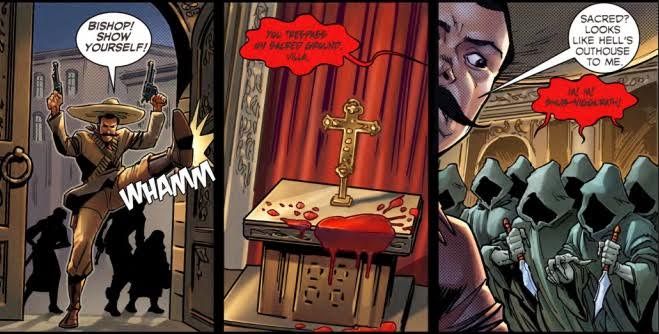
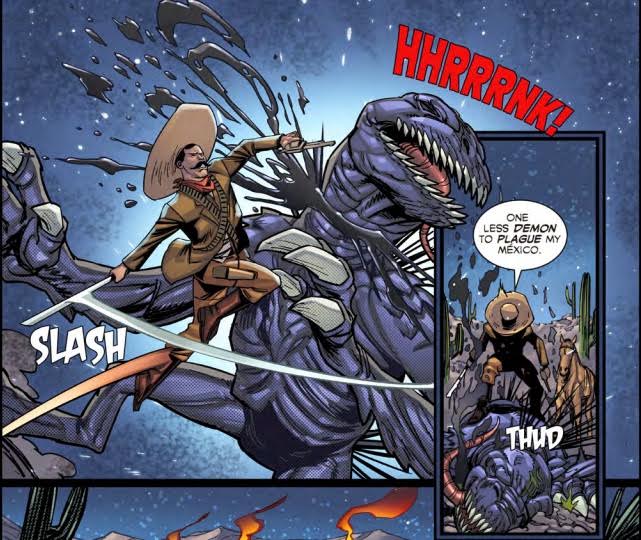
The chupacabra is not scary. Modern cryptozoologists have repeatedly confirmed that the “goat sucker” is usually just a coyote or wild dog with mange. Unless you’re reading Pancho Villa Monster Hunter, in which case the chupacabra has been repurposed into a servant of the crawling chaos, Nyarlathotep, one of H. P. Lovecraft’s cosmic horror gods who is determined to use monsters and eldritch magic to conquer Mexico in the throes of violent revolution.
This is the second ongoing book from Hector Rodriguez III, who became a Texas indie comic sensation with El Peso Hero, a superhero from the borderlands who fights both drug cartels and American overreach on immigration. Like El Peso Hero, Pancho Villa Monster Hunter is an action-packed exploration of the complicated politics of Mexico, swapping in monster for metahumans are the force of evil.
“Within Mexico's challenging social economics and internal turmoil, violence with organized crime, there's always a something greater than oneself, just a, demon monster, that nation is overcoming or fighting,” said Rodriguez in a phone interview. “I mean, the United States is no exception too, especially now in Texas. Something that appeals is having these characters pitted against something otherworldly because there's a sense of fascination. There's something's out of place.”
Rodriguez’s family has been in Texas since before statehood. Born near Eagle Pass, he moved with his family to College Station as a kid. His father, a National Guard, was huge comic nerd that would share his love of Spider-man and other books with his son. Once Rodriguez was grown and a teacher based in the Dallas-Fort Worth area, he began writing and drawing the book that became El Paso Hero.
From the beginning, he was willing to take hard looks at the racial politics of Texican culture. Like a lot of Chicano creators, he spoke out against the anti-immigrant policies of the Trump Administration. He first went viral in 2015 when he recreated a famous cover of Captain America where Cap punches Adolf Hitler with El Peso Hero and Trump. Responses ranged from raving to racist.
Repurposing the Lovecraft Mythos was intentional. The author was a contemporary of Villa’s, and his work channels the startling bigotry of his personal views through the idea of cosmic alienation. A typical Lovecraft story showed that mankind was meaningless against creatures so vast and incomprehensible that just looking at them could drive a person mad.
“It's something terrifying, you know, going above and beyond from our western spirituality and into the depths of what evil is,” said Rodriguez. “And then with the revolution, it was so muddled. Historically, there were so many hands involved and especially American interests being for and against and then just swapping sides. It was chaos, and that was perfect pairing with Lovecraft.”
Rodriguez isn’t the first to use the Lovecraft Mythos in a way its creator would probably hate. Thanks to a quirk of copyright law, all of Lovecraft is in the public domain. LGBTQIA+ people have been using his themes of isolation and monstrous change for years as a commentary on homophobia and transphobia. Matt Ruff’s Lovecraft Country and the subsequent HBO series turned the mythos into a blatant commentary on white supremacy. In comics, Geoff Sebesta had a time-displaced Busta Rhymes fight Lovecraft as he tried to use eldritch monsters to wipe out the Black race.
It pairs so well in Pancho Villa Monster Hunter largely because revolution is a kind of cosmic horror, at least to the elite. The French Revolution gave birth to modern antisemitic conspiracy theories of secret wizard cabals largely because overthrown nobles and their supporters could not comprehend the end of the system. There was a similar breaking of the mind as Villa led his uprising against both a local dictator and American interference. The fact that the media savvy Villa brought along film crews for his exploits to be turned into propaganda further drove supporters of his enemies into disbelief.
It was a war that created its own mythos, with Villa both lauded as an outlaw hero by some and hated as a murderer by others. Weaving those myths into America’s most prevalent created legendarium enhances both and shows how a revolution is always both a war of ideas and one of grounded truth.
“It's definitely a shift in reality,” said Rodriguez. “The characters are not able to understand what's going on, but they're witnessing this huge cosmic threat. I guess in our current world that would be the climate crisis and AI. The characters see the monster behind it all, but they still have to fight the revolution on the ground.”


Comments ()