
The Texas Artist Changing How We See Landscape
The Texas landscape has inspired artists since time out of mind. Rebecca Pugh, often working with mixed media, is no exception.
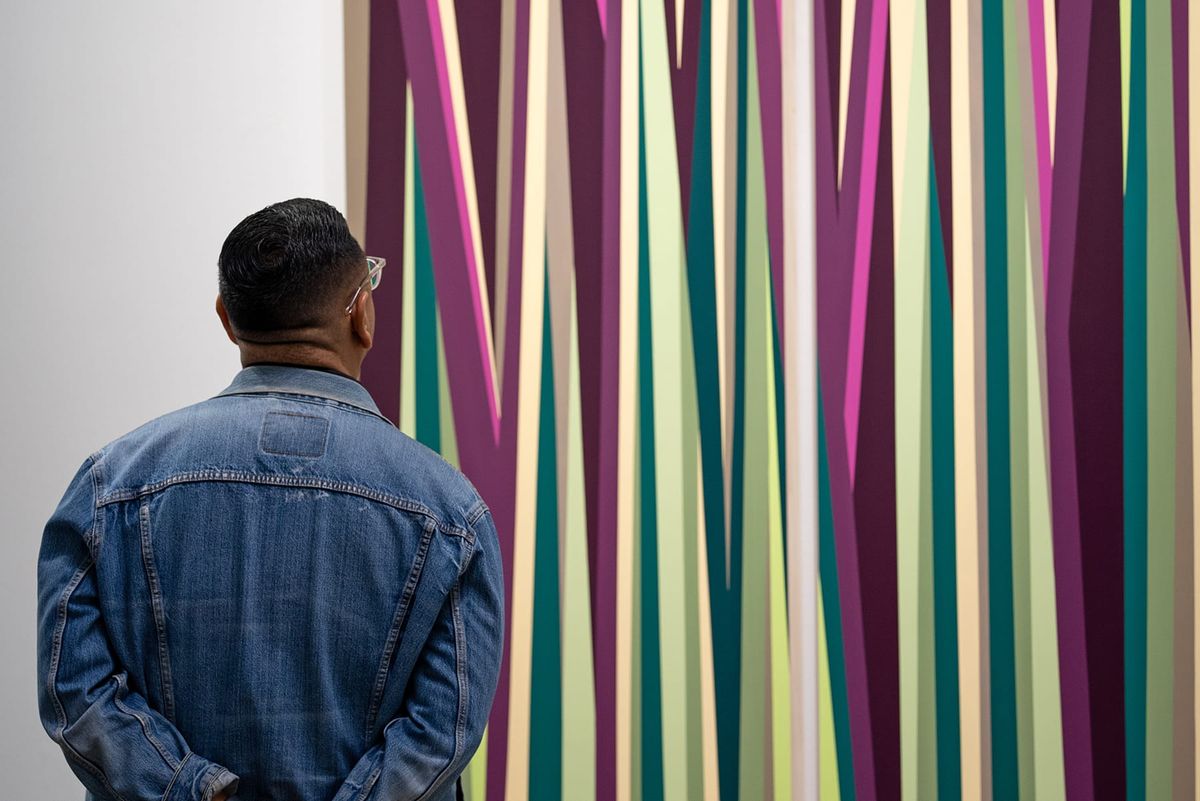
Driving through Texas cattle country, there is a lot of fence, sometimes unbroken miles of it. Staring at the fence as someone rushes past at five miles over the speed limit makes it blur into a set of abstract lines broken by the occasional cow or house. For most Texans, this is just a visual trick. Only Rebecca Pugh has painted it exactly as seen through her car window.
“My studio is in College Station, so I commute there twice a week, and I'm mesmerized by what I see,” said Pugh in a phone interview. “In the ditches of the roads, there's a lot of beauty in the long grass and the wildflowers. And I really love watching the changes throughout the different seasons.”
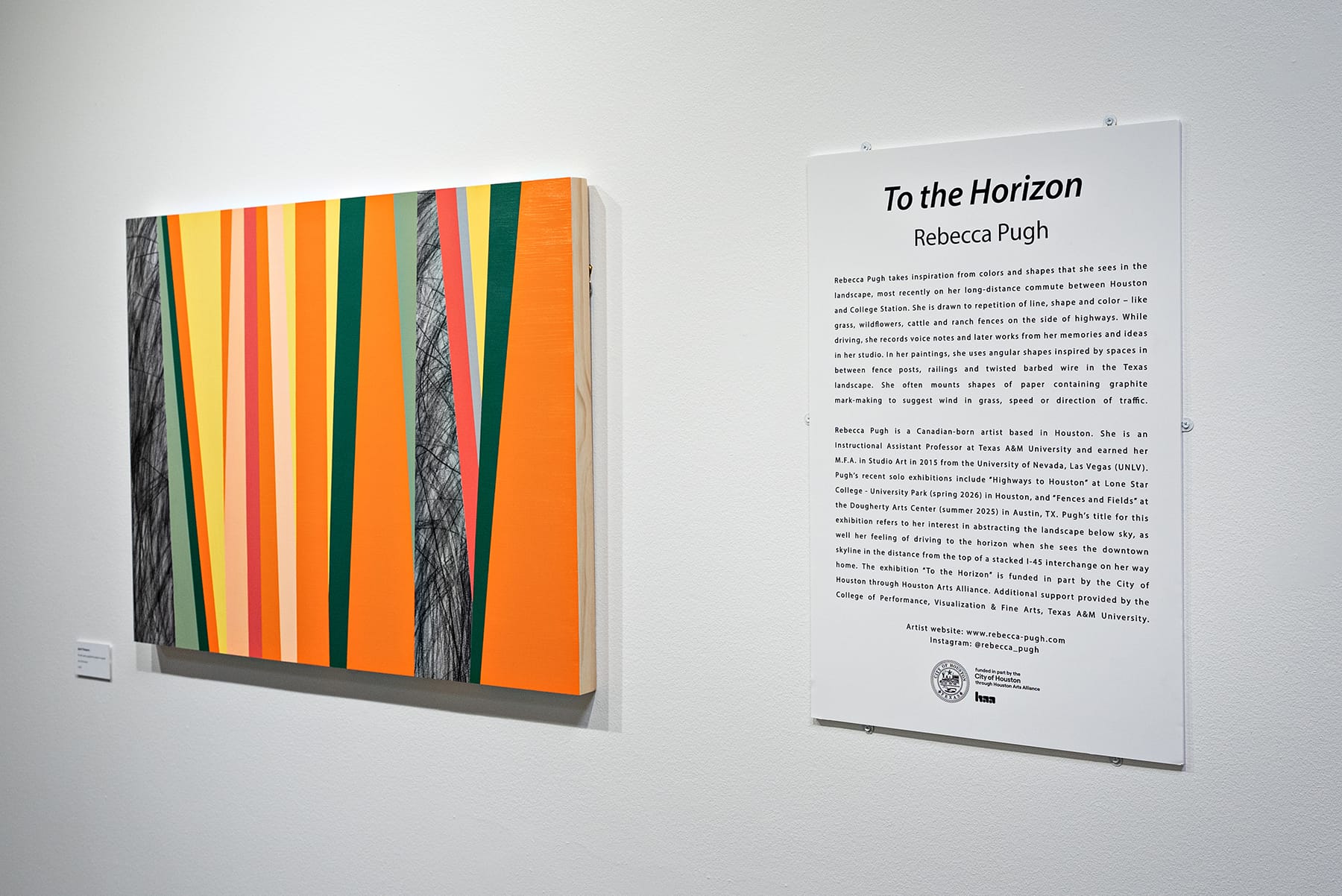
Pugh’s most recent exhibition, To the Horizon, is a perfect example of her strange approach to landscape art. Hung at Sawyer Yards, it’s a collection of abstract images drawn from her memories of the Texas countryside. Each scene has been reduced down to its basic shapes and colors. That fence is not a blurred, impressionist set of lines, but a dreamlike collective memory of the open road.
Though she now lives in downtown Houston, Pugh has been a seeker of new horizons all her life. She grew up on the shores of Thunder Bay, Ontario. Her backyard was Lake Superior, one of the largest freshwater lakes on Earth, and she spent hours entranced by the lines. She regularly visited her grandfather’s cabin and fell in love with an odd trick of the scenery.
“I would spend like each summer growing up at the cottage, and on the beach we had a very strong horizon line because is on a very narrow part of the lake,” she said. “So you see the other side of the lake kind of right across, but it's almost like a rectangular shape of trees and you've got sky above and the lake below.”
The lakeside wasn’t enough, though. In 2012, she moved to Las Vegas to attend the University of Nevada. Her primary goal was to get a degree, but she also wanted to explore the Mojave Desert, which is about as different as you can get from the arboreal Canadian shores and still be on Earth.
From there, she moved to Texas in 2020. Currently, she is an Instructional Assistant Professor at Texas A&M and Curator of Wright Gallery. She splits her time between College Station and Houston, where her husband works at a scientist at UH. It was a new type of landscape, but it still came down to colors and lines. Whether it was the flying concrete skyways of Houston’s freeway interchanges or the wildflower-strewn fields just outside of town, she continued.
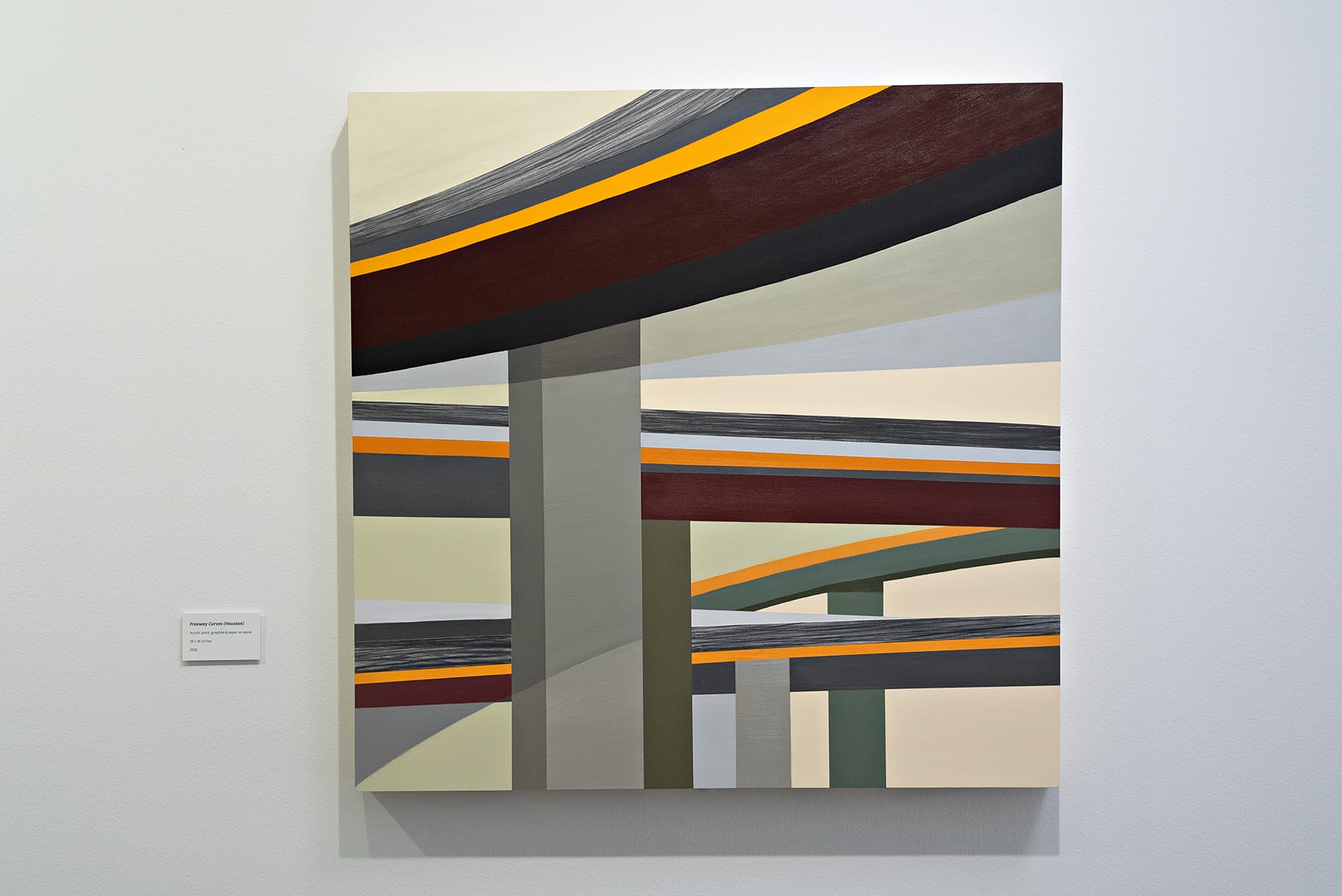
Nor is she limited to just painting. Many of her works incorporate mixed media into the final product such as graphite paper or strips of cloth. One of her first projects as an artist was freestanding canvases. These were designed to be looked at from all angles, adding dimensionality to the landscapes.
“It's just definitely a different format, which I really kind of enjoy the challenge of,” she said. “I'm working with the same colors and similar materials, paint on wood, and I really enjoy that process. I'm starting a new painting this week of grass, and I hope to show my work in Dallas.”
Pugh will get plenty of opportunities to explore the Texas landscape. In the last two years alone she’s had three solo exhibitions, with plans to hit most of the major cities in the state in the future. It’s an interesting cycle of creation. Pugh commutes to a city for art, gets inspired on the way, then has more art to conquer another gallery in a new town.
The Texas landscape has inspired artists since time out of mind. Big enough to cover two time zones, the state has ten major biomes from the Gulf Shore to arid mountains. It’s one thing to paint a pretty picture of familiar roads, beautiful flowers, and majestic livestock. It’s another to take those things, abstract them into basic lines and colors, and still perfectly capture the essence of the state. Sometimes she has to give visitors a little nudge, but when she does, the surge of recognition is immediate.
“When I had my show last summer in Austin, Fences and Fields, I kind of realized that it was important for the titles of the work to be shared with the viewer,” said Pugh. “One may not realize what I'm abstracting at all, you know, without the context. Now I’ve made it a priority to put wall labels beside my work.”

Comments ()