
A Texas Author Unleashes Schrödinger's Cat
The debut novel from acclaimed Houston poet and author Tomás Q. Morín centers on the most famous feline in physics

Schrödinger's cat has escaped both the confines of its original conception and its physical box in Houston poet and author Tomás Q. Morín’s debut novel Cat Love.
First, a refresher. Schrödinger's cat is a famous quantum physics thought experiment proposed by physicist Erwin Schrödinger in 1935. In it, a (keyword) hypothetical (end keyword) cat is placed in a sealed, opaque box with a flask of poison, a radioactive source, and a Geiger counter. If the counter detects atomic decay, the flask is broken and the cat poisoned.
Under mathematical wave functions in quantum systems proposed by Albert Einstein, Boris Podolsky, and Nathan Rosen at the time and elaborated on by Neil Bohr, the cat would be simultaneously alive and dead until observed because quantum particles could not separate. Schrödinger thought this was absurd and used the thought experiment to illustrate the flaw in the wave functions when paired with reality.
Since then, the experiment has become a pop culture staple used to describe absurd simultaneous dualities such as Schrödinger's douchebag, where an online troll is both joking or not joking depending on the target’s response. That’s a perfect touchstone for Morín’s novel, which deals both with a version of the experiment and a world where human feelings have been cruelly weaponized.
“I asked myself years ago what if the experiment was literal and not just a thought exercise?” said Morín in an email interview. “Which led to a big question: if that were true, what would the world have to be like then? and the people within it? The novel then became an attempt to answer those questions.”
Cat Love follows an unnamed female feline who is kidnapped by her catsitter while her owner (who she calls Mustache) is away. The cat is locked in a box for an “emotional statistics” course, which may or may not be a quack school. Students are brought in to stare at the box the cat is trapped in then given bizarre quizzes about their feelings. The quizzes are actually in the book, and they read like an alien wrote them.
Shortly after being locked in the box, the cat undergoes a metaphysical apotheosis allowing her to travel around the city and observer her observers. It’s a black humor tragicomedy narrated from the cat’s point of view, who remarks on everything from Clint Eastwood movies to capitalism.
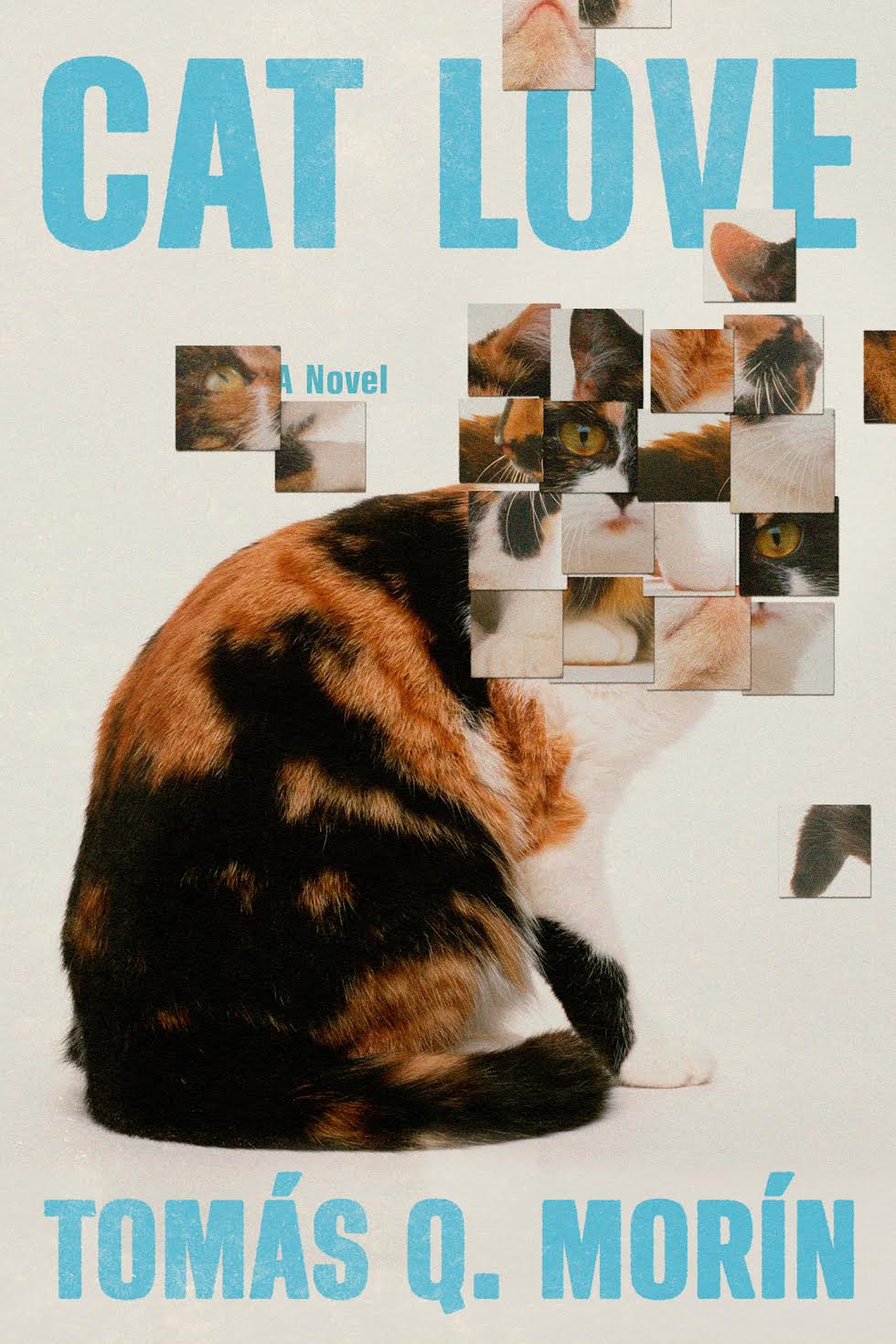
Morín is an associate professor of creative writing at Rice University. Born in the city of Maths just outside of Corpus Christi, he’s made a name for himself through his memoirs and collections of poetry, winning 2023 Vulgar Genius Nonfiction Award. Cat Love is his first novel, a new artform for him, but he believes it allows him to more fully explore the story.
The heart of the book is the cat’s observations on humanity, specifically how society has failed the people she loves while growing more and more superficially obsessed with feelings the way an app is obsessed with synergy. One student in the class, for instance, is training with his aunt to ram distracted drivers for only thinking about themselves, an absurdity worthy of Kurt Vonnegut. Through the cat, readers see how empathy can be turned into cruelty.
“We live in a time where you can’t go a day without coming across the word empathy, which is a good thing, and yet the world has never felt less safe,” said Morín. “Even on a local scale, I see people being unkind all the time. One day I wished there was a class like Defensive Driving but for feelings, a refresher course that would remind people what it looks like when we care about each other. I knew right away this would have to be a part of the book.”
The fact that people are trying to learn empathy by stealing a man’s cat and presumably letting it starve to death kind of explains everything you need to know about society. At least, the bits on fire.
The book is short and intense. Morín says it started out as bots of dialogue in his phone’s notes app, and that structure is present throughout. There are some pages with only a single line of prose, and the whole thing can easily be read in an afternoon.
The plot sounds grim, and at times it is, but there is a real hope for a better world as the plot progresses through the cat’s observations. While it’s hard to call the ending one that delivers justice, it does at least validate the love of good beings, feline and human.
“As small creatures in a very large world that does not center their needs, cats must be hyperaware of what people are feeling in order to anticipate what they might say or do next,” said Morín . “Their safety hinges on how well they can navigate our messy internal lives.”
Cat Love is available now. Morín will be touring Texas bookstores starting June 9. A full list can be found at his website.


Comments ()