
Abilene Art Show Accidentally Unleashes The Sinister
Drawing on sculptures across the state, the exhibit at the Center for Contemporary Arts, is designed to be seen from every angle while celebrating one of humanity’s oldest symbols
Faith Archambeau, Gallery Manager at Abilene’s Center for Contemporary Arts, didn’t initially set out to make a horror show with her sculpture exhibition, but when creepy, weird stuff started arriving she rolled with it.
“I guess I was gravitating more towards pieces that were darker,” she said in a phone interview. “It wasn’t really like a theme I was intending to go for, but when I was reading artists’ statements and different descriptions of the pieces, it seemed like people had very dark undertones.”
The show is called Circling, Spiraling, and it runs at the Center for Contemporary Arts through September 19. Drawing on sculptures across the state, pieces are designed to be seen from every angle while celebrating one of humanity’s oldest symbols. Whether it represents order from chaos or the reverse is up to the viewer, but either way the show is weirdly seductive,
The spiral in modern pop culture has become its own sort of devil. Junji Ito’s Uzumaki made it a terrifying meme spread across social media, and that was before HBO made a series about it. In The Magnus Archives, the Spiral is a literal eldritch god personifying lies, gaslighting, mazes, and the fear of being lost. The symbol is infectious, which might be why contributors turned in work that was unintentionally but inarguably dark.
One of those is Denton artist Jeff Felderhoff. His work is called The Discard. It’s a large ceramic stone of shimmery colors surrounded by a mass of twisting red ropes and looks like an idol out of an H. P. Lovecraft story. He says the entire purpose of its creation was to craft a sense of shock and despair.
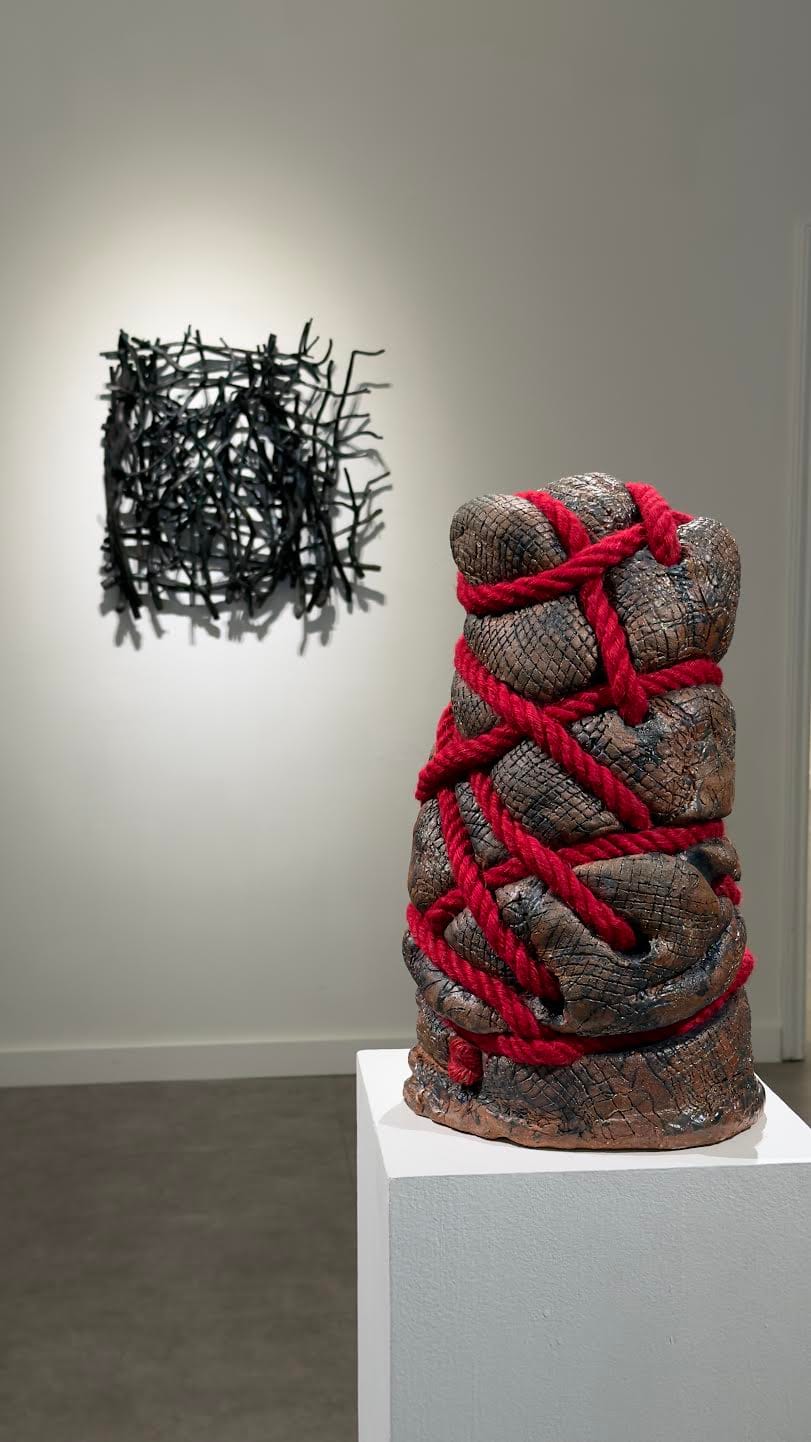
He accomplishes that masterfully. There is something facelike about the sculpture. Whether that’s just pareidolia or really clever craftsmanship is impossible to tell. The thing is just looking at you somehow, and it’s deeply unnerving.
“We often think of experiencing a doom spiral in times when we feel a sudden and profound loss of control combined with finding it impossibly difficult to secure that foothold we so desperately seek to steady ourselves, get our bearings, and attempt to recover,” he said in an email interview. “My work speaks directly to that, as far as my intentions are concerned, and I hope it was achieved with a level of intimacy and invitation to a topic that is a part of the shared human experience regarding loss, grief, and how we endure moments in that personal darkness.”
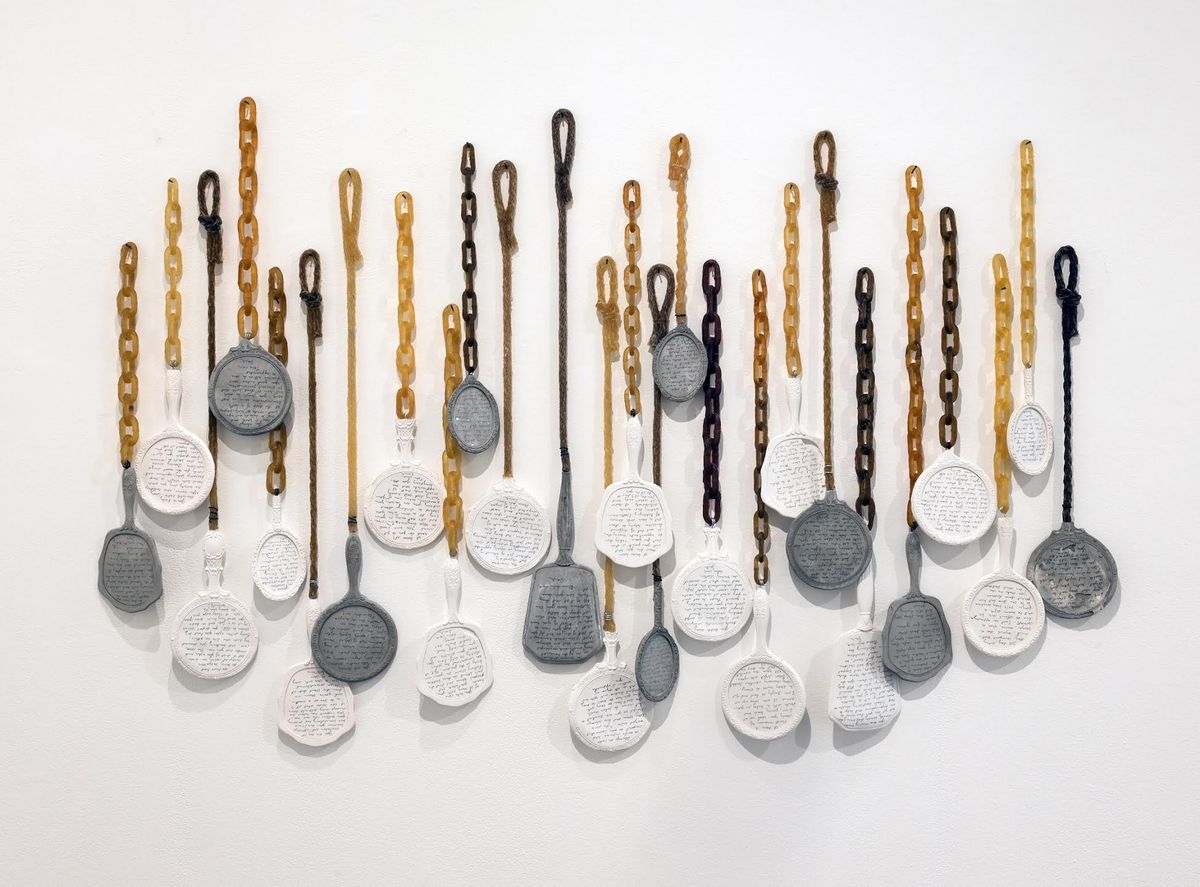
Sarah Hirneisen’s piece is more subtle but still possessed of a diabolical weirdness that captures how the spiral twists human society. The Austin artist built one of the few works made to only be seen from the front as Take Care hangs on the wall. However, even this isn’t straightforward.
Take Care is a set of concrete cast hand mirrors with thank you notes written on them. The notes are addressed to caretakers, probably the most necessary and least appreciated part of human society. Too often they are invisible, which is why Hirneisen hung them with the writing upside-down. If it was right-side-up, the eye could just glaze over them the way it does for the caretakers keeping the world running. Instead, Hirneisen makes viewers twist themselves to read, turning the spiral into an active act.
“I think that creates a direct connection to what Faith describes in her statement about the spiraling that can happen as we experience a sculpture,” she said in an email interview. “ With my work, you have to get up close and really engage with the piece, becoming absorbed in these non-reflective mirror surfaces as you try to decipher my cursive handwriting. There is a kind of physical and mental movement involved in that process.”
The Discard and Take Care have little in common with each other, but they manage to be representative of what Circling, Spiraling embodies as a show. The shape of the spiral cannot be divorced from the effect it has on the human mind, whether it is unraveling a puzzle or decaying a sane orbit.
Archambeau didn’t consider that when she began collecting the works, but it’s inescapable now. The exhibition is a unique collection of weirdness that is unsettling as it is amazing. It’s shined a light on an aspect of Texas art no one ever has before.
“I feel like you have to really look at them to get what the artist is saying and take in,” said Archambeau. “There’s a couple you can spin around. And then there’s one piece where you as you approach the piece, it glows and there’s like an oscillating orb. One is a condom full of bullets. Some are kind of weird when you look at them closely, but chaos is part of life.”
“Increasingly,” she added, after a small pause.



Comments ()